Whether you want to learn a new language, pick up guitar, master coding, start investing, or develop any other skill — cognitive science has clear, evidence-based answers for how to do it faster. The difference between a fast learner and a slow one is rarely talent. It is strategy. The right techniques — backed by decades of research — can cut learning time dramatically while improving long-term retention.
This guide covers how to learn any new skill faster using 12 proven techniques from cognitive psychology, neuroscience, and educational research. Each technique includes the science behind it, a practical “how to apply it” section, and examples for different skill types. No motivational fluff — just evidence.
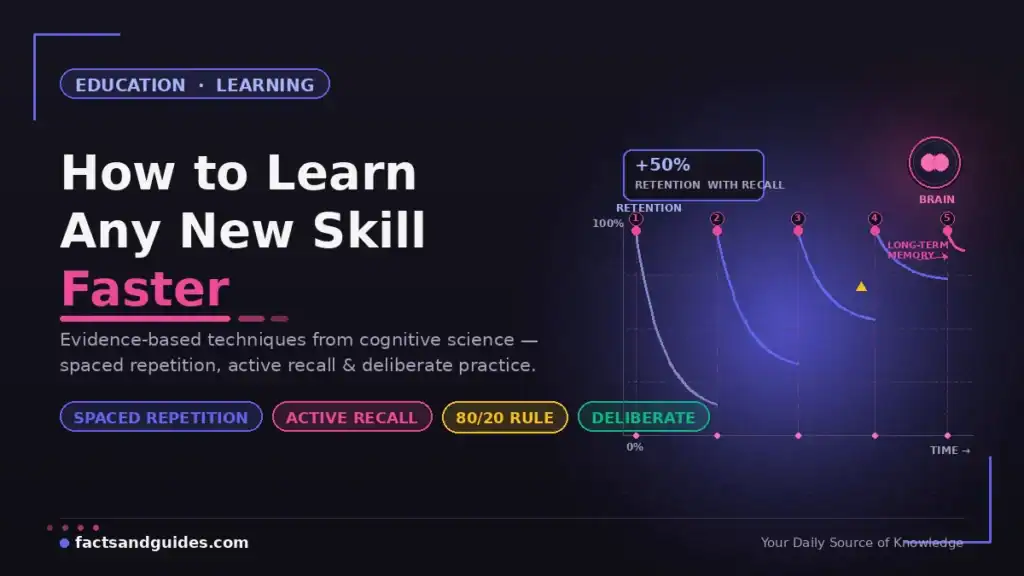
- Active recall (self-testing) produces 50% better retention than re-reading — it is the #1 learning technique Spaced repetition beats cramming by 200%+ for long-term memory Deliberate practice on your weaknesses beats comfortable repetition of what you already know The 80/20 rule applies to every skill — 20% of concepts cover 80% of practical use Sleep consolidates learning — studying then sleeping beats studying then staying awake Teaching what you learn (the Feynman technique) exposes knowledge gaps you did not know existed
How to Learn Any New Skill Faster: 12 Techniques at a Glance
| # | Technique | Evidence Strength | Best For | Time to See Results |
|---|---|---|---|---|
| 1 | Active Recall | ⭐⭐⭐⭐⭐ Very Strong | All learning | Immediate |
| 2 | Spaced Repetition | ⭐⭐⭐⭐⭐ Very Strong | Memorisation-heavy skills | 1–2 weeks |
| 3 | Deliberate Practice | ⭐⭐⭐⭐⭐ Very Strong | Performance skills | 2–4 weeks |
| 4 | The Feynman Technique | ⭐⭐⭐⭐ Strong | Conceptual understanding | Immediate |
| 5 | 80/20 Principle | ⭐⭐⭐⭐ Strong | All new skills | Day 1 |
| 6 | Interleaving | ⭐⭐⭐⭐ Strong | Problem-solving skills | 2–3 weeks |
| 7 | Sleep After Learning | ⭐⭐⭐⭐⭐ Very Strong | All learning | Next day |
| 8 | Chunking | ⭐⭐⭐⭐ Strong | Complex skills | Immediate |
| 9 | Desirable Difficulties | ⭐⭐⭐⭐ Strong | Deep learning | 2–4 weeks |
| 10 | Feedback Loops | ⭐⭐⭐⭐⭐ Very Strong | Performance skills | Immediate |
| 11 | Mindset (Growth vs Fixed) | ⭐⭐⭐ Moderate | Long-term motivation | Ongoing |
| 12 | Environment Design | ⭐⭐⭐⭐ Strong | Building consistency | Day 1 |
Science of Learning Techniques: The 4 Most Powerful Methods
These four techniques form the foundation of the science of learning. If you apply nothing else from this guide, apply these — they are the highest-impact methods for anyone wanting to learn a new skill fast.
1. Active Recall — The #1 Learning Technique on Earth
Active recall means testing yourself on material without looking at your notes — forcing your brain to retrieve information from memory. A landmark study by Roediger and Butler (2011) published in Science found that students who practised retrieval retained 50% more information than those who simply re-read the material. Re-reading feels productive. Testing yourself IS productive.
How to apply it: After studying a topic, close your book and write down everything you remember. Use flashcards (physical or Anki). After watching a lecture, summarise the key points from memory before reviewing your notes. The struggle to recall is what strengthens the memory.
2. Spaced Repetition — Never Forget What You Learn
Discovered by Hermann Ebbinghaus in 1885 and confirmed by hundreds of subsequent studies, spaced repetition means reviewing material at increasing intervals — 1 day, 3 days, 7 days, 14 days, 30 days. This combats the “forgetting curve” and moves information from short-term to long-term memory far more effectively than cramming.
How to apply it: Use the app Anki (free, open-source) — it automatically schedules reviews at optimal intervals based on how well you recall each card. For non-digital learners, use a Leitner box system with physical flashcards sorted into review intervals.
3. Deliberate Practice — Work on Your Weaknesses, Not Your Strengths
Psychologist Anders Ericsson’s research (the foundation behind the “10,000 hours” concept, which was widely misunderstood) shows that deliberate practice — focused work on specific weaknesses at the edge of your current ability with immediate feedback — produces far faster improvement than comfortable repetition. Here are key deliberate practice tips for applying this to any skill:
- Identify your specific weakness: Not “I need to get better at guitar” but “I need to improve my barre chord transitions between F and Bm”
- Isolate and drill that specific weakness repeatedly with full concentration
- Get immediate feedback: Record yourself, use a tutor, compare against a reference, or use an app that provides instant correction
- Operate at the edge of your ability: If it feels comfortable, it is not deliberate practice. Productive discomfort means you are growing.
4. The Feynman Technique — Teach It to Learn It
Named after Nobel Prize-winning physicist Richard Feynman, this technique forces deep understanding by making you explain a concept in the simplest possible language — as if teaching a child. If you cannot explain it simply, you do not understand it well enough.
How to apply it:
- Step 1: Study a concept
- Step 2: Write an explanation using only simple words (no jargon) — as if explaining to a 12-year-old
- Step 3: Identify where your explanation breaks down or gets vague — these are your knowledge gaps
- Step 4: Go back to the source material, fill the gaps, and simplify your explanation again
How to Learn a New Skill Fast: 8 More Evidence-Based Techniques
5. The 80/20 Principle — Learn the Vital 20% First
In most skills, roughly 20% of concepts account for 80% of practical utility. Identify this critical 20% and focus there first. In a new language, the 1,000 most common words cover 80–85% of everyday conversation. In programming, basic syntax + loops + conditionals + functions cover 80% of beginner-level coding. In cooking, 5 core techniques (sautéing, roasting, boiling, seasoning, knife skills) handle 80% of home recipes.
How to apply it: Before starting any skill, research: “What are the most important fundamentals?” Focus your first 20 hours exclusively on these high-impact areas.
6. Interleaving — Mix Topics Instead of Blocking
Interleaving means mixing different types of problems or topics within a single study session rather than practising one type exhaustively before moving to the next. Research by Bjork and others shows interleaving produces better long-term retention and transfer — even though blocked practice feels easier and more productive in the moment.
How to apply it: Instead of practising 50 addition problems, then 50 subtraction, then 50 multiplication — mix them: addition, multiplication, subtraction, addition, etc. When learning guitar, alternate between chords, scales, and songs rather than doing 30 minutes of chords alone.
7. Sleep After Learning — Memory Consolidation Is Real
Harvard Medical School research found that participants who slept after learning a skill performed 20–30% better on tests the next day compared to those who stayed awake. During sleep, your brain replays and consolidates new learning, transferring it from temporary to permanent storage. Pulling an all-nighter to learn more is counterproductive.
How to apply it: Schedule your most important learning sessions in the evening (1–2 hours before sleep). Sleep 7–8 hours. Your brain will do the consolidation work while you rest. Never sacrifice sleep for extra study time. To understand more about how your brain consolidates memories, read our 25 Facts About the Human Brain.
8. Chunking — Break Complex Skills into Small, Manageable Pieces
Chunking means breaking a complex skill into small, discrete sub-skills and mastering each one individually before combining them. Your working memory can hold only 4–7 items at once. Chunking reduces cognitive load by organising information into meaningful groups.
How to apply it: Do not try to “learn guitar.” Instead, learn: how to hold the instrument → how to press strings cleanly → 4 basic chords → transitioning between 2 chords → strumming patterns → combining chords and strumming into a simple song. Each chunk is small enough to master in 1–3 sessions.
9. Desirable Difficulties — Harder Practice = Deeper Learning
Robert Bjork’s “desirable difficulties” framework shows that making learning slightly harder improves long-term retention. This includes testing yourself instead of re-reading (active recall), spacing practice sessions (spaced repetition), mixing problem types (interleaving), and varying practice conditions. These techniques feel harder in the moment but produce significantly stronger learning.
10. Immediate Feedback Loops — Know If You Are Right or Wrong Instantly
Feedback is the accelerator of learning. The faster you know whether you did something correctly, the faster you can adjust. Research consistently shows that immediate feedback produces faster skill development than delayed feedback.
How to apply it: Use apps with instant correction (Duolingo for languages, coding sandboxes for programming). Record yourself performing a skill and compare against a reference. Work with a tutor or coach who provides real-time corrections. In any skill, shorten the gap between action and feedback.
11. Growth Mindset — Believe Ability Is Developable
Carol Dweck’s research at Stanford shows that people with a growth mindset (believing abilities can develop through effort) learn faster, persist longer through difficulty, and recover from failures more quickly than those with a fixed mindset (believing talent is innate). This is not just motivational — brain imaging studies show growth-mindset individuals have different neural responses to errors.
How to apply it: When you struggle, reframe from “I can’t do this” to “I can’t do this yet.” View errors as information (what to practise), not as evidence of inability. Track your progress weekly — seeing improvement over time reinforces the growth mindset naturally.
12. Environment Design — Make the Right Action the Easy Action
Behavioural research shows that reducing friction for desired behaviours is more effective than relying on motivation. Want to practise guitar daily? Leave it on a stand in the middle of your room, not in a case in the closet. Want to study coding every evening? Keep your laptop open to the code editor before you sit down.
Deliberate Practice Tips: How to Apply These Techniques to Specific Skills
Here are deliberate practice tips tailored to common skills people want to learn fast:
| Skill | 80/20 Focus | Best Techniques | Recommended Tool |
|---|---|---|---|
| New Language | 1,000 most common words + basic grammar | Spaced repetition + active recall + immersion | Anki flashcards + Duolingo + podcasts |
| Programming | Variables, loops, conditionals, functions | Deliberate practice + immediate feedback + projects | freeCodeCamp + LeetCode + build projects |
| Musical Instrument | 4–6 basic chords + simple strumming | Chunking + deliberate practice + recording self | YouTube tutorials + metronome app |
| Writing | Structure + clarity + editing | Feynman technique + feedback + daily practice | Write daily + read good writers |
| Public Speaking | Structure + eye contact + pacing | Deliberate practice + recording + feedback | Record speeches + Toastmasters |
| Cooking | 5 core techniques + seasoning | Chunking + interleaving + immediate feedback | YouTube + practice 3x/week |
30-Day Starter Plan: How to Learn Any New Skill Faster in Practice
Here is a practical 30-day plan showing how to learn any new skill faster by applying the 12 techniques above in sequence.
| Week | Focus | Techniques Used | Daily Time |
|---|---|---|---|
| Week 1 (Days 1–7) | Identify the 80/20 fundamentals. Chunk the skill into sub-skills. Set up environment. | 80/20, Chunking, Environment Design | 30–45 min |
| Week 2 (Days 8–14) | Start deliberate practice on the first 2–3 chunks. Begin spaced repetition for facts/vocabulary. | Deliberate Practice, Spaced Repetition, Active Recall | 45–60 min |
| Week 3 (Days 15–21) | Interleave between chunks. Teach what you have learned (Feynman). Seek feedback. | Interleaving, Feynman Technique, Feedback Loops | 45–60 min |
| Week 4 (Days 22–30) | Combine sub-skills into whole performance. Record and review. Identify next-level weaknesses. | Deliberate Practice, Sleep, Growth Mindset | 60 min |
7 Learning Mistakes That Slow You Down
1. Re-Reading Instead of Self-Testing
Re-reading feels productive but produces weak memory traces. Active recall (testing yourself without notes) produces 50% better retention. Close the book and write what you remember.
2. Cramming Before Tests or Deadlines
Massed practice (cramming) works for short-term recall but fails for long-term retention. Spaced repetition over days and weeks beats cramming by 200%+ for lasting memory.
3. Practising Only What You Are Already Good At
Comfortable repetition feels rewarding but produces minimal improvement. Deliberate practice targets your weaknesses — the uncomfortable areas where growth actually happens.
4. Not Getting Feedback
Practising without feedback means you might be reinforcing mistakes. Record yourself, use apps with instant correction, find a mentor, or join a community that provides honest evaluation.
5. Trying to Learn Too Many Things Simultaneously
Focus on 1–2 new skills at a time. Spreading attention across 5 different skills means none get enough deliberate practice time to produce meaningful improvement.
6. Skipping Sleep to Study More
Sleep is not downtime — it is when your brain consolidates what you learned. Cutting sleep to add study time is counterproductive. Study less, sleep more, retain more.
7. Quitting During the “Valley of Disappointment”
Most skills have a frustrating early phase where effort does not seem to produce visible results. This is normal — progress is non-linear. Breakthroughs often come after weeks of seemingly flat progress. Growth mindset and tracking your practice help you push through.
Best Free Tools to Learn a New Skill Fast
| Tool | Technique It Supports | Cost | Best For |
|---|---|---|---|
| Anki | Spaced repetition + active recall | Free (desktop/Android) | Languages, medical, exams |
| Notion | Note-taking + Feynman summaries | Free | All learning |
| Duolingo | Spaced repetition + gamification | Free (with premium option) | Languages |
| freeCodeCamp | Deliberate practice + projects | Free | Programming |
| YouTube | Chunked tutorials + visual learning | Free | Everything |
| Forest App | Focus / environment design | Free | Avoiding phone distractions |
For a comprehensive list of learning platforms, read our Best Free Online Learning Platforms in India. And for more evidence-based focus strategies, check our 15 Productivity Techniques Backed by Science.