Education Guides India — Study Techniques, Exam Preparation and Career Guidance
Education guides India needs are the ones that actually understand what Indian students face — high-stakes board exams, fiercely competitive entrance tests (JEE, NEET, UPSC, CAT, state-level), parental pressure across generations, and the increasingly important challenge of staying skilled after graduation. Facts & Guides Education brings clear, research-backed, India-aware guidance for students, parents and lifelong learners at every stage.
What Education coverage includes
The Education section covers six core areas: study techniques students can apply based on cognitive science research (spaced repetition, active recall, interleaving, retrieval practice), JEE NEET preparation tips alongside guidance for other major entrance exams, career guidance after 12th covering both traditional and emerging paths, scholarships Indian students can apply for at national and state levels, higher education abroad in the US, UK, Canada, Australia and Germany, and continuing education for working professionals.
Study techniques students should actually use
Active recall and spaced repetition
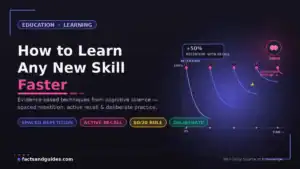
Study techniques students benefit from most are grounded in cognitive science. Active recall — testing yourself rather than re-reading notes — produces dramatically better long-term retention than passive review. Spaced repetition through tools like Anki flashcards optimizes the spacing of reviews so material moves into long-term memory efficiently. The Pomodoro technique (25-minute focused study + 5-minute break) maintains attention across long study days. Interleaving subjects in a single session rather than blocking by subject improves problem-solving flexibility.
Reading retention and note-taking
Effective reading retention comes from active engagement with the text — making notes, generating questions, summarizing in your own words. Note-taking systems like Cornell notes, the Feynman technique and structured outlines all outperform simple highlighting. Teaching concepts aloud as if explaining to someone else identifies gaps in understanding immediately. These techniques apply across school subjects, board exam preparation and entrance exam prep equally.
JEE NEET preparation tips and major entrance exams
JEE Main and JEE Advanced strategy
JEE NEET preparation tips for engineering aspirants center on mastering NCERT Class 11 and 12 first, then building depth through HC Verma (Physics), NCERT plus OP Tandon (Chemistry), and RD Sharma plus Cengage Mathematics. Previous 10 years of papers are essential. Weekly mock tests from January of the exam year identify weak areas. JEE Main has two attempts per year (January and April) — plan accordingly. Maintain a formula notebook and error log throughout preparation.
NEET preparation for medical aspirants
NEET is the single national entrance for MBBS, BDS, BAMS, BHMS and BVSc across all Indian government and private medical colleges including AIIMS and JIPMER. Preparation focuses on NCERT Biology (75% of the Biology paper comes directly from NCERT), Physics from HC Verma and DC Pandey, Chemistry from NCERT plus OP Tandon. AIIMS Delhi has the highest cutoff among AIIMS institutes (~99.7 percentile typically), with newer AIIMS being slightly more accessible.
UPSC Civil Services and other government exams
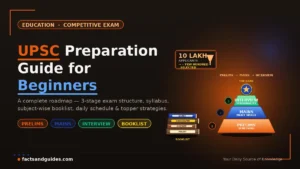
UPSC Civil Services preparation is a 12–18 month commitment for serious aspirants. Stage 1 (Prelims) is objective and qualifying only. Stage 2 (Mains) involves nine descriptive papers including optional subject. Stage 3 (Interview) tests personality and current affairs depth. Standard preparation materials include NCERT (Classes 6–12) for foundation, Laxmikanth (Polity), Spectrum (Modern History), Bipan Chandra (History), Shankar IAS (Environment), and current affairs through The Hindu and Indian Express.
Career guidance after 12th — beyond engineering and medicine
Career options after 12th Science
Career guidance after 12th Science traditionally meant Engineering or Medicine, but emerging fields offer strong career paths: Data Science, Artificial Intelligence, Cybersecurity, Biotechnology, Genetics, Forensic Science, Environmental Science, Aerospace, Design (NID, NIFT), Architecture (NATA), Law (5-year integrated programs via CLAT), Defense (NDA), Hotel Management, Mass Communication, Pilot training and Maritime services. CUET opens central universities for general degrees.
Career options after 12th Commerce
Career options after 12th Commerce include BCom (Hons), BBA, BMS, Chartered Accountancy via CA Foundation, Company Secretary, Cost Management Accountancy, Economics (BA/BSc), Hotel Management, Mass Communication, integrated BBA-LLB, Banking & Finance, Actuarial Science, Statistics, and emerging fields like Business Analytics, Financial Risk Management (FRM), CFA and Digital Marketing. Chartered Accountancy remains highly respected with strong placement potential.
Scholarships Indian students should apply for
Scholarships Indian students often miss are the ones with manageable application processes and meaningful funding. National scholarships covered include the National Scholarship Portal (NSP) schemes, Inspire Scholarship for science students, KVPY, and state-specific scholarships. For abroad studies, merit scholarships include Fulbright-Nehru, Chevening (UK), Rhodes Scholarship, DAAD (Germany), Commonwealth scholarships, and university-specific aid. Apply 12–18 months before intake. Need-based aid requires strong academics plus financial documentation. Do not pay agencies for "guaranteed" scholarships — most are scams.
Higher education abroad — country comparison
Higher education abroad options for Indian students are detailed by country. USA: research universities, strong STEM and business programs, F1 visa process, GRE/GMAT/SAT requirements, costs $40,000–$70,000/year. UK: 1-year master's programs, Tier 4 visa, IELTS requirement, costs £20,000–£35,000/year. Canada: post-graduate work permits, PR pathways. Australia: post-study work visa. Germany: low-cost public universities, German language requirement for non-English programs. Application timelines, document requirements and decision factors are covered in dedicated guides.
For working professionals — continuing education
Education guides India offers for working professionals cover online certifications (Coursera, edX, Udacity, Swayam, NPTEL), MOOCs from top universities, India-specific certifications, upskilling for AI-era careers (data science, machine learning, product management), and graduate school applications for working professionals (one-year MBA programs, executive education). Soft skills, communication and leadership development are covered alongside technical upskilling.