The internet is flooded with productivity advice — morning routines of billionaires, “hustle harder” motivational quotes, and productivity apps that promise to transform your life. Most of it is based on anecdote, survivorship bias, or marketing. This article is different. Every technique listed here has been validated through published scientific research — peer-reviewed studies, meta-analyses, or experimental data from psychology, neuroscience, and organisational behaviour.
These 15 productivity techniques backed by science are not theories. They are methods that have been tested on real people in controlled settings and shown measurable improvements in focus, output, and work quality. Choose 2–3 that fit your work style, implement them for two weeks, and keep what works.
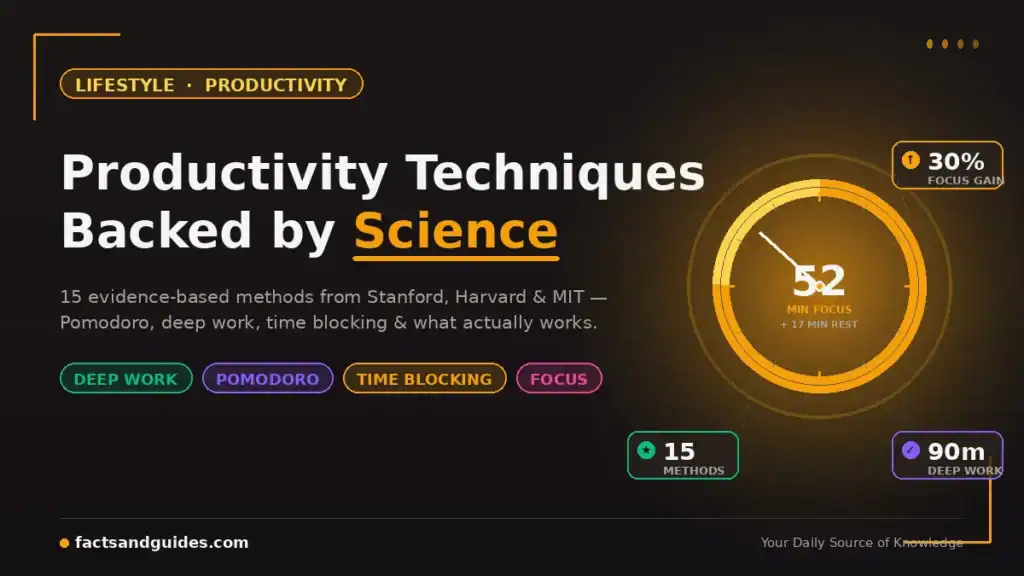
- Single-tasking beats multitasking — Stanford research proves multitaskers perform worse on every metric The Pomodoro Technique works, but the optimal ratio is ~52 minutes work + 17 minutes rest (DeskTime data) Time blocking is more effective than to-do lists for completing important work Environment design reduces the need for willpower — remove distractions before they tempt you Sleep is the #1 productivity tool — even 1 hour of sleep loss reduces cognitive performance by 30% The most effective productivity system is the one you actually use consistently
Quick Reference: 15 Science-Backed Productivity Tips at a Glance
| # | Technique | Evidence Strength | Best For | Time to Implement |
|---|---|---|---|---|
| 1 | Single-Tasking | ⭐⭐⭐⭐⭐ Strong | Everyone | Immediate |
| 2 | Pomodoro Technique | ⭐⭐⭐⭐ Strong | Sustained focus work | Immediate |
| 3 | Time Blocking | ⭐⭐⭐⭐ Strong | Professionals with meetings | 1 day |
| 4 | Deep Work Sessions | ⭐⭐⭐⭐ Strong | Creative/knowledge workers | 1 week |
| 5 | Environment Design | ⭐⭐⭐⭐ Strong | Easily distracted people | 30 minutes |
| 6 | Goal Setting (SMART) | ⭐⭐⭐⭐⭐ Very Strong | Everyone | 15 minutes |
| 7 | Two-Minute Rule | ⭐⭐⭐ Moderate | People overwhelmed by tasks | Immediate |
| 8 | Eisenhower Matrix | ⭐⭐⭐ Moderate | Decision-makers | 15 minutes |
| 9 | Zeigarnik Effect | ⭐⭐⭐⭐ Strong | Writers/creators | Immediate |
| 10 | Sleep Optimisation | ⭐⭐⭐⭐⭐ Very Strong | Everyone | 1 week |
| 11 | Exercise for Cognition | ⭐⭐⭐⭐⭐ Very Strong | Everyone | 1 week |
| 12 | Batching Similar Tasks | ⭐⭐⭐ Moderate | Email/admin-heavy roles | 1 day |
| 13 | Implementation Intentions | ⭐⭐⭐⭐ Strong | Procrastinators | 5 minutes |
| 14 | Strategic Breaks | ⭐⭐⭐⭐ Strong | Desk workers | Immediate |
| 15 | Time Management Training | ⭐⭐⭐⭐ Strong (meta-analysis) | Students/professionals | Ongoing |
Focus and Deep Work Strategies: How to Do Your Best Thinking
The ability to focus deeply on cognitively demanding work is becoming the most valuable skill in the modern economy. These focus and deep work strategies are among the most powerful science-backed productivity tips you can adopt.
1. Single-Tasking Over Multitasking — Stanford University Research
Research from Stanford University found that people who regularly multitask are worse at filtering relevant information, have slower task-switching speeds, and have poorer working memory compared to those who single-task. What we call “multitasking” is actually rapid task-switching — and every switch costs you 15–25 minutes of refocusing time (a phenomenon researchers call “attention residue”).
How to apply: When working on an important task, close all unrelated browser tabs, put your phone in another room (not just face-down — physically remove it), and commit to one task until it is complete or until your designated break.
2. The Pomodoro Technique — Optimised by DeskTime Data
The classic Pomodoro Technique prescribes 25 minutes of focused work followed by a 5-minute break. However, DeskTime, a productivity tracking company, analysed the habits of their top 10% most productive users and found that the optimal ratio was 52 minutes of work followed by 17 minutes of genuine rest. The exact numbers matter less than the principle: alternating focused work with real breaks produces better sustained performance than grinding without stopping.
How to apply: Set a timer for 50–52 minutes. Work with full focus. When the timer rings, take 15–17 minutes of genuine rest — walk, stretch, look out the window. Do NOT check email or social media during breaks, as that is still cognitive work.
3. Deep Work Sessions — Cal Newport’s Framework
Cal Newport’s “Deep Work” framework, supported by research in cognitive psychology, argues that the ability to perform focused, uninterrupted work on cognitively demanding tasks is both increasingly rare and increasingly valuable. Deep work sessions of 90–120 minutes (aligned with the brain’s natural ultradian rhythm) produce disproportionately more high-quality output than fragmented hours.
How to apply: Schedule 1–2 “deep work blocks” of 90 minutes each day. During these blocks: no email, no Slack, no meetings, no phone. Protect this time like you would protect a meeting with your CEO — because it is more valuable.
4. Environment Design — Remove Temptation Before It Tempts You
Research in behavioural psychology consistently shows that your environment has a more powerful influence on your behaviour than your willpower. Every time you resist checking your phone, scrolling social media, or opening a distracting tab, you deplete a limited cognitive resource. The solution: design your environment so that the right behaviour is the easiest behaviour.
How to apply: Put your phone in another room during work hours. Use website blockers (Cold Turkey, Freedom, or Focus) for social media and news sites during deep work. Close all browser tabs except what you are working on. Keep your workspace clean and uncluttered — visual clutter competes for your attention.
Time Management Techniques Research: Proven Scheduling Methods
These time management techniques backed by research help you structure your day for maximum output.
5. Time Blocking — Protect Your Priorities on the Calendar
Research shows that scheduling specific blocks of time for specific types of work is significantly more effective than open-ended to-do lists. When your calendar reflects your priorities rather than just your meetings, you are far more likely to make progress on important but non-urgent work (what Eisenhower called “Quadrant II” activities). Cal Newport, among others, has documented this extensively.
How to apply: At the start of each day (or the evening before), block your calendar into segments: deep work blocks, admin/email blocks, meeting blocks, and break blocks. Treat deep work blocks as non-negotiable appointments with yourself.
6. The Eisenhower Matrix — Prioritise by Urgency × Importance
Named after President Dwight Eisenhower, this matrix categorises tasks into four quadrants to help you focus on what actually matters rather than what feels urgent.
| Urgent | Not Urgent | |
|---|---|---|
| Important | Q1: DO NOW (crises, deadlines) | Q2: SCHEDULE (planning, learning, exercise — high-value work) |
| Not Important | Q3: DELEGATE (most emails, some meetings) | Q4: ELIMINATE (social media scrolling, busywork) |
How to apply: At the start of each day, categorise your to-do list into these four quadrants. Spend maximum time in Q2 (important but not urgent) — this is where real growth, learning, and strategic progress happen. Most people live in Q1 (firefighting) and Q3 (reactive), which is exhausting and unsustainable.
7. Batching Similar Tasks — Reduce Context-Switching Cost
Context-switching between different types of tasks is cognitively expensive. Research shows that grouping similar tasks together (all emails at once, all phone calls together, all writing in one block) reduces the attention residue penalty and allows your brain to stay in one cognitive mode for longer.
How to apply: Check and respond to email in 2–3 designated batches per day (e.g., 9 AM, 1 PM, 5 PM) rather than continuously. Group all meetings into one section of the day. Batch all administrative tasks into one 30-minute block.
8. The Two-Minute Rule — Clear Trivial Tasks Instantly
From David Allen’s Getting Things Done methodology: if a task takes less than two minutes, do it immediately rather than adding it to your to-do list. The reasoning is practical — the cognitive overhead of recording, remembering, and eventually completing a trivial task exceeds the effort of just doing it now.
Best Productivity Methods from Psychology Research
These are the best productivity methods grounded in decades of psychology and cognitive science experiments.
9. Specific Goal Setting — Locke & Latham’s Goal-Setting Theory
One of the most robustly validated findings in organisational psychology: specific, challenging goals lead to significantly higher performance than vague “do your best” goals. Locke and Latham’s (2002) meta-analysis across hundreds of studies showed effect sizes of 0.5–0.8 — meaning goal-setting alone improves performance by 25–40%. In one foundational study, truck drivers given specific loading targets achieved dramatically more than those told to “do your best.”
How to apply: Instead of “work on the report,” write: “Complete sections 2 and 3 of the Q3 report by 12 PM.” Instead of “exercise more,” write: “Walk 30 minutes at 7 AM on Monday, Wednesday, Friday.” Specificity drives action.
10. Implementation Intentions — The “If-Then” Hack for Procrastination
A meta-analysis by Gollwitzer and Sheeran (2006) found that implementation intentions — pre-deciding when, where, and how you will perform a task — increase follow-through by 2–3x. The format is simple: “If [situation], then I will [action].”
How to apply: Instead of “I’ll study today,” write: “If it is 6 PM and I am home, then I will sit at my desk and study Polity for 45 minutes.” Pre-deciding removes the in-the-moment decision paralysis that leads to procrastination.
11. The Zeigarnik Effect — Use Unfinished Tasks to Your Advantage
Psychologist Bluma Zeigarnik discovered that people remember uncompleted tasks better than completed ones. Your brain keeps “processing” unfinished work in the background. You can exploit this by deliberately leaving a task slightly unfinished at the end of a work session — your subconscious will continue working on it, and you will find it much easier to resume the next day.
How to apply: When writing, stop mid-paragraph instead of at the end of a section. When coding, stop mid-function. Hemingway famously used this technique, stopping each day mid-sentence so he could pick up effortlessly the next morning.
Science-Backed Productivity Tips: Body and Brain Optimisation
The most overlooked science-backed productivity tips have nothing to do with apps or techniques — they are about optimising the hardware your brain runs on.
12. Sleep Is Your #1 Productivity Tool — Not Optional
Research from the Harvard Medical School and the Walker Sleep Lab at UC Berkeley is unequivocal: even moderate sleep deprivation (6 hours instead of 8) reduces cognitive performance by approximately 30%. Creativity, decision-making, emotional regulation, and memory consolidation all degrade significantly without adequate sleep. After 17 hours without sleep, cognitive impairment is equivalent to a blood alcohol level of 0.05%.
How to apply: Prioritise 7–8 hours of sleep consistently. No productivity technique, supplement, or stimulant can compensate for chronic sleep deprivation. If you have to choose between studying an extra hour and sleeping an extra hour, sleep wins every time.
13. Exercise Boosts Cognitive Function — 20 Minutes Is Enough
A meta-analysis in the British Journal of Sports Medicine found that even a single 20-minute session of moderate exercise improves attention, memory, and executive function for several hours afterward. Regular exercise increases BDNF (brain-derived neurotrophic factor), promotes neuroplasticity, and reduces stress hormones that impair focus.
How to apply: Schedule a 20–30 minute walk, run, or gym session before your most important work block. Even a brisk walk around the block counts. The cognitive benefits are immediate and last for hours.
14. Strategic Breaks — Rest Is Productive, Not Lazy
Research from the University of Illinois found that brief diversions from a task dramatically improve sustained attention. Working for long stretches without breaks leads to “vigilance decrement” — your brain gradually loses the ability to maintain focus. Strategic breaks reset your attention system.
How to apply: Take a genuine 10–15 minute break every 50–90 minutes. Genuine means: walk, stretch, look at nature, hydrate. NOT: check email, scroll social media, or switch to another cognitive task.
15. Time Management Training — A Meta-Analysis Confirms It Works
A 2021 meta-analysis by Aeon and colleagues, published in PLOS ONE, analysed 158 studies and found that time management training is moderately related to improved job performance, academic achievement, and reduced stress. The most effective components were goal-setting, prioritisation, and scheduling — not specific apps or tools. The research confirms that time management is a learnable skill, not an innate trait.
5 Productivity Myths Science Has Debunked
| Myth | What Research Actually Shows |
|---|---|
| “Multitasking makes you faster” | Stanford: Multitaskers perform worse on attention, memory, and task-switching than single-taskers. |
| “Morning people are more productive” | Chronotype research shows peak performance time varies by individual. Match your hardest work to YOUR peak, not someone else’s. |
| “Busy = productive” | Busyness and productivity are unrelated. Answering 100 emails is busy. Completing one strategic project is productive. |
| “More hours = more output” | Stanford: Productivity per hour drops sharply after 50 hours/week. Beyond 55 hours, additional work is nearly zero output. |
| “Willpower is unlimited” | Baumeister’s ego depletion research shows willpower is a finite resource. Design your environment instead of relying on discipline. |
Sample Daily Routine: Applying the Best Productivity Methods Together
| Time | Activity | Technique Used |
|---|---|---|
| 6:30 AM | Wake up, hydrate, 20-min walk/exercise | Exercise for cognition (#13) |
| 7:30–9:00 AM | Deep Work Block 1 — most important task | Deep work (#3) + single-tasking (#1) + environment design (#4) |
| 9:00–9:15 AM | Break — walk, stretch, look at nature | Strategic breaks (#14) |
| 9:15–9:45 AM | Email batch + 2-minute tasks | Batching (#7) + two-minute rule (#8) |
| 10:00–11:30 AM | Deep Work Block 2 — second priority task | Time blocking (#5) + Pomodoro (#2) |
| 11:30–12:00 PM | Admin, calls, meetings | Eisenhower Q3 delegation (#6) |
| 12:00–1:00 PM | Lunch + genuine rest | Strategic breaks (#14) |
| 1:00–2:30 PM | Collaborative work / meetings | Batching (#7) |
| 2:30–3:30 PM | Email batch + lighter tasks | Batching (#7) |
| 3:30–4:00 PM | Plan tomorrow + set specific goals | Goal setting (#9) + implementation intentions (#10) |
| 4:00 PM | Stop working. Leave something slightly unfinished. | Zeigarnik effect (#11) |
| 10:00 PM | Sleep (7–8 hours) | Sleep optimisation (#12) |
For more on building consistent habits, read our guide on How to Build a Sustainable Morning Routine. And for learning new skills efficiently, check our How to Learn Any New Skill Faster guide.