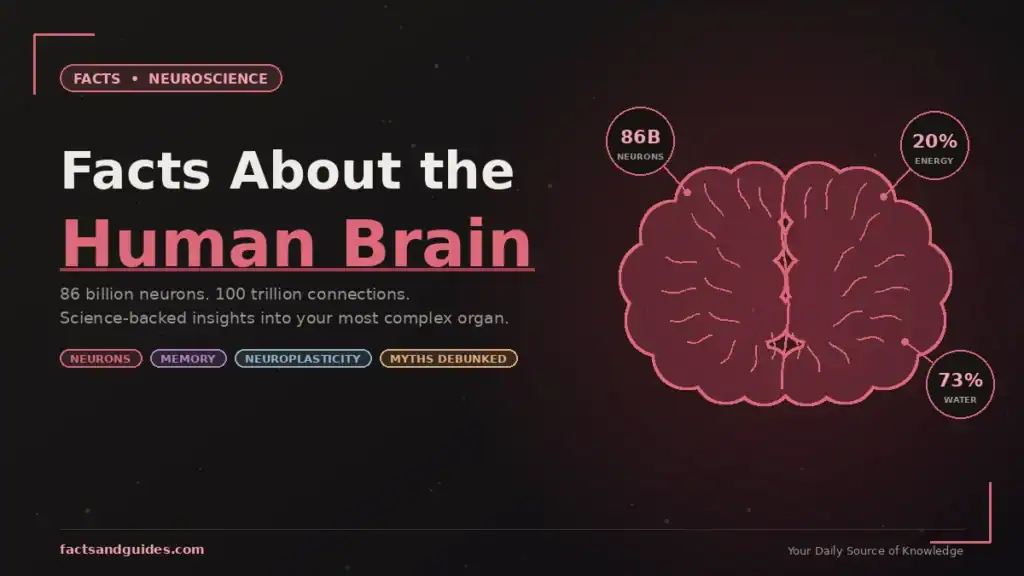
The human brain is arguably the most complex structure in the known universe. Weighing just 1.4 kilograms — about 2% of your body weight — it contains 86 billion neurons, consumes 20% of your total energy, can store the equivalent of 2.5 million gigabytes of data, and processes 11 million bits of information every single second. And yet, most of what we know about the brain has been discovered in just the last 15 years.
These facts about the human brain go far beyond basic trivia. Based on neuroscience research from institutions like MIT, Northwestern University, the National Institutes of Health, and the Djavad Mowafaghian Centre for Brain Health, this guide covers everything from how your brain generates electricity and processes memories to the myths that most people still believe.
- Your brain has 86 billion neurons forming roughly 100 trillion connections The brain can store approximately 2.5 petabytes (2.5 million GB) of data It processes images in just 13 milliseconds — faster than a blink of an eye Neuroplasticity means your brain can rewire itself at any age, not just childhood The “you only use 10% of your brain” claim is a complete myth Your brain doesn’t fully mature until approximately age 25
Facts About the Human Brain: Power, Size & Structure
Understanding how the brain works starts with appreciating its incredible physical properties. These interesting facts about the brain reveal just how powerful this small organ truly is.
Fact 1: Your Brain Generates Enough Electricity to Power a Light Bulb
The brain operates on approximately 12–20 watts of electrical power — roughly enough to illuminate a small LED bulb. This electricity is generated by billions of neurons firing electrical impulses to communicate with each other. Despite consuming this modest amount of power, the brain performs computations that outpace the world’s most powerful supercomputers in specific tasks like pattern recognition and language processing.
Fact 2: You Have Approximately 86 Billion Neurons
Each of your 86 billion neurons can form connections with up to 10,000 other neurons, creating a network of roughly 100 trillion synaptic connections. This network is what enables everything from controlling your heartbeat to solving complex mathematical equations to feeling emotions. The number of possible neural connections in a single human brain exceeds the number of stars in the Milky Way galaxy.
Fact 3: Your Brain Uses 20% of Your Body’s Energy — Despite Being Only 2% of Your Weight
The brain is an energy-hungry organ. It requires a constant flow of oxygen and glucose, consuming approximately 20% of your total energy intake even at rest. When you are thinking hard, solving problems, or learning something new, energy consumption in active brain regions can increase further. This is why skipping meals can make you feel mentally foggy — your brain is literally running low on fuel.
Fact 4: About 60% of Your Brain Is Fat
The human brain is the fattiest organ in the body, composed of approximately 60% fat. These lipids are not wasted space — they are essential for maintaining the structural integrity of cell membranes and ensuring proper communication between neurons. This is why healthy dietary fats (omega-3 fatty acids from fish, nuts, and seeds) are genuinely important for brain health.
Fact 5: Your Brain Is About 73% Water
Even mild dehydration — as little as 2% — can measurably affect cognitive performance, attention, short-term memory, and mood. Studies show that dehydrated people perform worse on tasks requiring concentration and make more errors. Simply drinking adequate water throughout the day has a direct, measurable impact on your mental performance.
Interesting Facts About the Brain: Speed & Processing Power
Fact 6: The Brain Processes Images in Just 13 Milliseconds
Research conducted at MIT found that the brain can identify and process entire images in as little as 13 milliseconds — far faster than a blink of an eye, which takes 300–400 milliseconds. This means your brain has already recognised and categorised a visual scene roughly 25 times before you even finish blinking. This speed is what enables you to instinctively catch a ball thrown at you or swerve to avoid an obstacle while driving.
Fact 7: Brain Signals Travel at Speeds Up to 440 km/h
Signals in the brain travel at speeds ranging from 1.5 to 440 kilometres per hour, depending on the type of neuron and the urgency of the signal. Touch-a-hot-stove pain signals travel at the fastest speeds (via myelinated A-delta fibres), while dull aches travel much slower. The fastest brain signals can cross the length of your body in a fraction of a second.
Fact 8: Your Brain Processes 11 Million Bits of Information Every Second
The brain’s neural network processes roughly 11 million bits of sensory information every single second. However, your conscious mind can only handle about 40–50 bits per second. This means over 99.99% of the information your brain processes happens completely below your conscious awareness — regulating body temperature, digestion, balance, breathing, and thousands of other functions without you ever noticing.
How the Brain Works: Memory, Learning & Dreams
Fact 9: Your Brain Can Store 2.5 Petabytes of Data
According to Paul Reber, Professor of Psychology at Northwestern University, the human brain has an estimated storage capacity of approximately 2.5 petabytes (2.5 million gigabytes). That is equivalent to roughly 300 years of continuous TV watching or 3 million hours of video. Unlike a computer hard drive, the brain does not “run out” of storage — though retrieval of older memories can become less efficient over time.
Fact 10: Memories Are Not Stored Like Video Recordings — They Are Reconstructed
Most people imagine memory works like a video camera — recording experiences perfectly and playing them back faithfully. Research from the Djavad Mowafaghian Centre for Brain Health has debunked this completely. Memory is reconstructive: your brain pieces together the past using fragments of experience combined with general knowledge, emotions, expectations, and assumptions. This is why eyewitness testimony is notoriously unreliable and why different people remember the same event differently.
Fact 11: Sleep Is When Your Brain Consolidates Memories
Your brain does not rest while you sleep — it works intensely. During sleep, the brain replays and consolidates the day’s experiences, transferring important information from short-term to long-term memory. Research published in 2025 showed that specific sleep stages (particularly slow-wave sleep and REM sleep) each play distinct roles in different types of memory consolidation. This is why pulling an all-nighter before an exam often backfires — your brain needs sleep to properly store what you studied.
Fact 12: Your Brain Generates 4–7 Dreams Per Night
Most people dream 4–7 times each night during REM (Rapid Eye Movement) sleep, totalling approximately 2 hours of dreaming. However, most dreams are forgotten within 5 minutes of waking. Dreams appear to play a role in emotional processing, memory consolidation, and creative problem-solving — though the exact purpose of dreaming remains one of neuroscience’s open questions.
Fact 13: Infant Memories Form Much Earlier Than Previously Believed
A 2026 study published in Science Times revealed that babies create memories within their first year of life — much earlier than scientists previously thought. The reason we cannot recall our earliest memories as adults (called “infantile amnesia”) is not because the memories were never formed, but because the brain’s retrieval systems were still developing at that age.
Neuroplasticity Facts: Your Brain Can Rewire Itself at Any Age
One of the most important discoveries in modern neuroscience is neuroplasticity — the brain’s ability to change its structure and function in response to experience, learning, or injury. These neuroplasticity facts have completely overturned the old belief that adult brains are fixed and unchangeable.
Fact 14: Your Brain Forms New Neural Pathways Every Single Day
Neuroplasticity is not a rare exception — it is a fundamental property of the nervous system. Every time you learn a new skill, practise an instrument, study a new language, or even change a daily habit, your brain physically rewires itself by strengthening existing connections and forming new ones. A 2026 article in Medical Xpress confirmed that neuroplasticity occurs throughout life, though it operates more selectively in adulthood compared to childhood.
Fact 15: The Brain Can Recover After Injury by Reassigning Functions
After a stroke or traumatic brain injury, undamaged regions of the brain can sometimes take over functions previously handled by the damaged area. Research from Dr. Lara Boyd at the Djavad Mowafaghian Centre for Brain Health demonstrated measurable neuroplastic changes in stroke patients through targeted movement exercises — regardless of age. Recovery is strongest in younger brains but continues throughout life with proper therapy and repetition.
Fact 16: Learning a Musical Instrument Physically Changes Your Brain
Brain imaging studies show that musicians have measurably larger and more densely connected brain regions associated with motor control, auditory processing, and coordination compared to non-musicians. These changes are visible on brain scans and demonstrate how repeated, focused practice literally reshapes the physical structure of the brain.
Brain Development: From Birth to Adulthood
Fact 17: A Newborn’s Brain Triples in Size During the First Year
At birth, the brain weighs about 350 grams and accounts for roughly 10% of body weight. By age one, it has nearly tripled to about 1 kilogram. This explosive early growth reflects the formation of billions of synaptic connections as the infant learns to see, hear, move, and communicate. Many of these excess connections are later “pruned” to improve efficiency — a process as important as the growth itself.
Fact 18: Your Brain Does Not Fully Mature Until About Age 25
The prefrontal cortex — responsible for decision-making, planning, impulse control, and understanding consequences — does not fully mature until approximately age 25. This has significant implications for understanding adolescent behaviour, risk-taking, and why car insurance rates are higher for under-25s. The teenage brain is not broken — it is simply still under construction.
Fact 19: The Brain Develops in Five Distinct Life Stages
Rather than simply declining after adulthood, the brain undergoes major reorganisations at specific ages: massive synaptic growth in infancy, efficiency pruning around age 9, prefrontal maturation in the early twenties, network stabilisation in the thirties, and compensatory rewiring in later decades that supports resilience despite neuron loss. These findings reshape how scientists view brain ageing — it is not simply a story of decline.
5 Quirky and Surprising Brain Facts
- The brain cannot feel pain. While it processes pain signals from the rest of the body, the brain itself has no pain receptors. This is why brain surgery can be performed while the patient is awake — a technique that helps surgeons avoid damaging critical areas.
- Your brain sees faces everywhere. The phenomenon called pareidolia — seeing faces in clouds, toast, or car headlights — happens because the brain has a dedicated face-processing region (the fusiform face area) that is always scanning for faces, even when none exist.
- 95% of decisions happen subconsciously. According to research published in Science Daily, the vast majority of your decisions, behaviours, and reactions occur due to brain activity below your conscious awareness. Your “gut feelings” are actually your brain’s subconscious calculations.
- The brain’s texture is similar to tofu. Despite its incredible power, the human brain has a soft, jelly-like consistency comparable to tofu or soft gelatin. It is extremely delicate, which is why it is encased in a hard skull and surrounded by cerebrospinal fluid for cushioning.
- Your brain generates about 50,000 thoughts per day. Research suggests the average person has approximately 50,000–70,000 thoughts daily. Most of these are repetitive — the same worries, plans, and mental loops cycling through your mind.
Brain Myths Debunked: 5 Things Most People Get Wrong
Despite advances in neuroscience, several persistent myths about the brain continue to circulate. Here are 5 brain myths debunked by modern research.
| Myth | Reality | Source |
|---|---|---|
| “We only use 10% of our brain” | Brain scans show that virtually all regions are active. You use all of your brain — different regions activate for different tasks. | NIH / Science Times |
| “Left-brained = logical, right-brained = creative” | Brain imaging shows both hemispheres work together for nearly all tasks. There is no evidence that people are dominated by one side. | University of Utah (2013 study of 1,000+ brains) |
| “Brain damage is permanent and irreversible” | Neuroplasticity allows the brain to rewire and recover after injury. Rehabilitation can restore lost functions even in adults. | DMCBH / Dr. Lara Boyd |
| “Bigger brains = higher intelligence” | Intelligence relates more to neural efficiency, connectivity, and structural factors — not brain volume alone. | National Institutes of Health |
| “Alcohol kills brain cells” | Moderate alcohol consumption alters brain function temporarily but does not directly kill neurons. Heavy chronic use does cause damage. | Science Times |
How to Keep Your Brain Healthy: Evidence-Based Tips
Understanding these facts about the human brain is fascinating — but applying them to protect your brain health is even more valuable. Here are science-backed strategies:
- Sleep 7–8 hours consistently. Sleep is when your brain consolidates memories, clears metabolic waste, and repairs itself. Chronic sleep deprivation is linked to increased risk of Alzheimer’s disease and cognitive decline.
- Exercise regularly — even walking helps. Physical exercise increases blood flow to the brain and promotes the production of BDNF (brain-derived neurotrophic factor), which supports neuron growth and survival. A 2026 study found that a lifetime of mental and physical stimulation may cut Alzheimer’s risk by up to 38%.
- Stay hydrated. Your brain is 73% water. Even 2% dehydration impairs concentration, memory, and mood.
- Learn something new regularly. Learning a new skill, language, or instrument strengthens neural pathways through neuroplasticity. Novelty and challenge are what drive brain growth.
- Eat healthy fats. Omega-3 fatty acids (from fish, walnuts, flaxseeds) support brain cell membrane integrity and reduce inflammation.
- Maintain social connections. Social interaction engages multiple brain networks simultaneously and is consistently linked to better cognitive health in ageing populations.
Interested in how what you eat affects your brain? Read our guide on The Science of Spices: How Indian Spices Benefit Your Health. And for more fascinating science, check out our Facts About Artificial Intelligence — the technology modelled after the human brain.
The Human Brain by the Numbers
| Brain Statistic | Number |
|---|---|
| Weight | ~1.4 kg (3 lbs) |
| Percentage of body weight | ~2% |
| Energy consumed | ~20% of total body energy |
| Neurons | ~86 billion |
| Synaptic connections | ~100 trillion |
| Storage capacity | ~2.5 petabytes (2.5 million GB) |
| Information processed per second | ~11 million bits |
| Conscious processing per second | ~40–50 bits |
| Image processing speed | 13 milliseconds |
| Signal speed (fastest) | Up to 440 km/h |
| Water content | ~73% |
| Fat content | ~60% |
| Dreams per night | 4–7 |
| Thoughts per day | ~50,000–70,000 |
| Full maturity age | ~25 years |