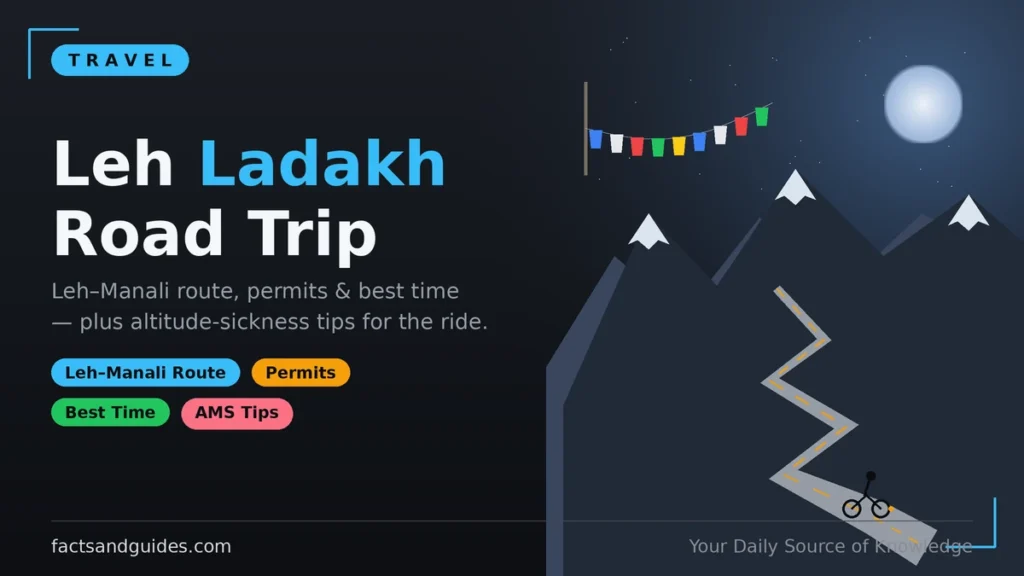
A Leh Ladakh road trip is the journey almost every Indian rider and driver puts on their list, and for good reason: the Manali-Leh Highway climbs across four passes above 15,000 feet, crosses a high-altitude desert that looks like nowhere else in the country, and rewards you with landscapes that make every ordinary highway feel flat afterwards. But it is also one of the few road trips in India where poor planning does not just spoil the holiday — it can put your health at real risk. Altitude, fuel gaps of 345 km, and roads that only open for a few months a year mean this trip demands preparation, not improvisation.
This guide gives you the full 2026 picture: when the route actually opens, the now-simplified permit system, the stage-by-stage Leh to Manali route, where the fuel and overnight halts are, and how to acclimatise so that Acute Mountain Sickness does not end your trip on day two. The single biggest change for 2026 is on permits — the old Inner Line Permit has been scrapped for Indian travellers and replaced by an online Environmental Development Fee. Get the timing, the permits and the acclimatisation right, and the rest of a Leh Ladakh road trip is simply about enjoying the ride.
- The Manali-Leh Highway typically opens around mid-to-late May and closes by late October or early November, set by BRO snow clearance. Indian travellers no longer need an Inner Line Permit — you now pay an online Environmental Development Fee (₹400 + ₹20/day) plus a small Red Cross fee. The route has one fuel gap of roughly 345 km between Tandi and Karu, so you must fill up fully and carry reserve fuel. Never sleep at Sarchu on the way up — its altitude (around 14,000 ft) causes severe AMS; halt at Keylong or Jispa instead. A two-day drive each way plus two rest days in Leh is the minimum sensible plan; 7–10 days total is ideal. Acclimatisation is non-negotiable: rest 48 hours in Leh before going higher, hydrate, and avoid alcohol.
When to Plan Your Leh Ladakh Road Trip in 2026
Timing controls everything on a Leh Ladakh road trip, because the high passes are simply impassable for more than half the year. The Manali-Leh Highway closed for all vehicles on 20 November 2025, and based on the pattern of recent years, BRO snow clearance points to a reopening around 15–25 May 2026 — though heavy winter snow can push that by a week or two. The road then stays open until roughly late October or early November before winter shuts it again.
The table below summarises the season month by month so you can match your dates to the experience you want. Early season gives you dramatic snow walls but rougher roads and water crossings; the peak months offer the best infrastructure; and September is the connoisseur’s choice for clear light and thinner crowds.
| Period | Manali-Leh Highway | What to expect |
|---|---|---|
| Nov–Apr | Closed | Fly into Leh only; passes under snow |
| Mid-May–early June | Just opened | Snow walls, water crossings, rough patches; bikes sometimes restricted early |
| July–Aug | Fully open | Best infrastructure; some monsoon landslide risk on the Manali side |
| September | Open | Clear skies, stable weather, fewer crowds — the sweet spot |
| October | Closing window | Cold but quiet; road can shut on short notice |
If this is your first Leh Ladakh road trip, aim for late August or September. The roads are at their best, water crossings have calmed down, and the weather is stable. Avoid the first fortnight after opening unless you are an experienced rider comfortable with snow, slush and unpredictable conditions near Baralacha La.
Leh to Manali Route: Stage by Stage
The Leh to Manali route — or Manali to Leh, depending on your direction — runs roughly 430 km via the Atal Tunnel and crosses four high passes: Baralacha La (around 16,000 ft), Nakee La, Lachulung La (around 16,600 ft) and Tanglang La (around 17,500 ft). Since the Atal Tunnel opened, you no longer need to grind over Rohtang Pass; the tunnel drops you into Lahaul in about two hours from Manali, bypassing the worst of the old road. Most travellers break the Leh to Manali route over two days, which is both safer for acclimatisation and far more enjoyable than a brutal 14–16 hour single push.
Here is the route broken into its key stages, with the realistic overnight halts marked. The golden rule of the Leh to Manali route is to sleep low on the first night — which is why Keylong and Jispa, not Sarchu, are the right choice heading north.
| Stage | Approx. distance | Altitude / notes |
|---|---|---|
| Manali → Keylong/Jispa (via Atal Tunnel) | ~115 km | Keylong ~3,100 m, Jispa ~3,200 m — best night-one halt |
| Jispa → Baralacha La → Sarchu | ~90 km | Sarchu ~4,300 m — do NOT sleep here on the way up |
| Sarchu → Gata Loops → Pang | ~80 km | The famous 21 hairpin Gata Loops; Nakee La and Lachulung La |
| Pang → Tanglang La → Leh | ~120 km | Tanglang La ~17,500 ft; smooth tarmac descent into Leh |
One critical point on the Leh to Manali route applies only when heading towards Ladakh: Indian nationals need no special permit for the highway itself, and you do not need any permit at all when travelling from the Leh side down to Manali. If you choose the old Rohtang Pass road instead of the Atal Tunnel, you will need a separate Rohtang permit booked online — but the tunnel makes that unnecessary for almost everyone.
Fuel on the Manali Leh Highway
Fuel is the logistics issue that catches out the most travellers on the Manali Leh Highway. After Manali, the last reliable petrol pump is at Tandi, about 110 km in (Keylong has had a pump since 2021 as a backup). The next pump is at Karu, roughly 30 km before Leh — a gap of around 345 km with no official fuel. You must fill your tank completely at Tandi and carry reserve fuel, especially on a motorcycle.
Beyond fuel, facilities on the Manali Leh Highway are sparse: hotels at Keylong and Jispa, tented camps at Sarchu and Pang, ATMs only at Keylong, and limited medical help at Sissu, Keylong and army camps in emergencies. Mobile network is mostly dead between Jispa and Upshi, so download offline maps and tell someone your plan before you lose signal. If you are choosing a machine for this terrain, our guide to the best bikes for Himalayan touring is worth a read before you book a rental.
Ladakh Permit 2026: What Has Changed
The Ladakh permit 2026 situation is simpler than the old guides suggest, because the system was overhauled. For Indian citizens, the Inner Line Permit (ILP) has been abolished — you no longer apply for an ILP at all. In its place is a mandatory online Environmental Development Fee (EDF): currently ₹400 per person as a one-time environment fee, plus ₹20 per person per day, plus a small ₹10 per day Red Cross contribution. You register and pay online before arrival and carry the printed receipt, which is what gets checked at the restricted-area checkpoints.
This Ladakh permit 2026 fee applies even if you only stay around Leh town. Foreign nationals still follow a separate Protected Area Permit process. You do not need any permit to visit Leh town itself or nearby sights like Thiksey and Hemis monasteries, Lamayuru or Magnetic Hill — the fee-based clearance is for the restricted border zones such as Nubra Valley, Pangong Tso, Tso Moriri and Hanle.
| Item (Indian travellers, 2026) | Detail |
|---|---|
| Inner Line Permit (ILP) | Abolished — no longer required |
| Environment fee (one-time) | ₹400 per person |
| Wildlife / daily fee | ₹20 per person per day |
| Red Cross fee | ₹10 per person per day |
| Where to apply | Official Ladakh administration portal, online before arrival |
| Zones needing the fee receipt | Nubra, Pangong, Tso Moriri, Hanle, Khardung La and other border areas |
A practical note many travellers miss: some readings of the rules tie restricted-zone access to a mandatory acclimatisation period in Leh before you head higher. Whether or not it is strictly enforced as paperwork, the underlying advice — settle in Leh first, then go to the high lakes — is exactly what your body needs anyway. Print at least two copies of your fee receipt, as checkpoints keep one.
AMS Prevention on a Ladakh Trip
Acute Mountain Sickness is the single biggest health risk on any Leh Ladakh road trip, and AMS prevention deserves more attention than the route map. Leh sits at about 3,500 m, and the high lakes and passes go well beyond that. As altitude rises, the air thins and each breath delivers less oxygen; if you climb faster than your body can adapt, AMS sets in. It does not care how fit you are — even athletes get hit. The only real protection is acclimatisation: giving your body time to adjust.
The core AMS prevention protocol is straightforward. Spend a minimum of 48 hours in Leh before going higher, with near-complete rest on day one and only light activity on day two. Follow the “climb high, sleep low” principle, drink four to five litres of water a day, avoid alcohol entirely for the first few days, and do not push to a higher sleeping altitude when you already have symptoms. Mild headache, nausea and breathlessness are common; worsening symptoms mean you descend, not continue.
Building AMS prevention into your route
Good AMS prevention is mostly about route design. This is exactly why you sleep at Keylong or Jispa rather than Sarchu on the drive up from Manali — Sarchu is higher than Leh itself, and a night there before your body has adapted is a recipe for a miserable, dangerous evening. If you fly into Leh instead of driving up, the rule is even stricter: do nothing strenuous for the first 48 hours, because you have skipped all the gradual altitude gain a road trip provides.
Because medical facilities en route are minimal, sensible travellers also sort out cover before leaving home. It is worth checking whether domestic travel insurance is worth it for a high-altitude trip, since standard policies sometimes exclude adventure activities above certain altitudes.
How to Get to Ladakh and Choose Your Mode
There are three broad ways to do a Leh Ladakh road trip, and your choice shapes both cost and acclimatisation. Driving or riding up the Manali Leh Highway gives you the gradual altitude gain that helps your body adapt, plus the full road-trip experience. Flying into Leh from Delhi, Mumbai or Srinagar is the only option from November to April and saves days, but it dumps you straight at 3,500 m — so the 48-hour rest becomes absolutely mandatory. The third option is the Srinagar-Leh Highway, which usually opens earlier (around late March to April) and offers a gentler altitude profile, with Kashmir thrown in.
Cost varies widely by mode. Based on recent traveller reports, a budget HRTC bus run can cost roughly ₹1,500–2,500 per person including food and basic stays; a shared taxi about ₹2,000–2,500 per person; self-drive around ₹5,000–8,000 per person in fuel, food and accommodation; and a private taxi for the vehicle ₹18,000–22,000, before Leh sightseeing is added. The table compares the trade-offs.
| Mode | Acclimatisation | Rough cost | Best for |
|---|---|---|---|
| Self-drive / ride (Manali-Leh) | Good — gradual gain | ₹5,000–8,000 per person | Riders, full experience |
| HRTC / shared taxi | Good — same route | ₹1,500–2,500 per person | Budget travellers |
| Fly into Leh | Poor — sudden altitude | Flight + 48h rest | Short on time, winter |
| Srinagar-Leh Highway | Gentle gradient | Varies | Easier ascent, Kashmir add-on |
If you are travelling onward by train to reach Manali or Chandigarh first, booking early matters in peak summer; our IRCTC Tatkal booking guide covers the timing if regular seats are gone.
A Practical 8-Day Leh Ladakh Road Trip Itinerary
Here is a tested, acclimatisation-first itinerary for a Leh Ladakh road trip starting from Manali. It builds in the safe overnight halts, the mandatory Leh rest, and the headline sights — Nubra Valley and Pangong Tso — without rushing your body up the altitude curve. Adjust the lake days to suit your permit zones and energy.
| Day | Plan | Night halt (altitude) |
|---|---|---|
| Day 1 | Manali → Keylong/Jispa via Atal Tunnel; fuel up at Tandi | Jispa (~3,200 m) |
| Day 2 | Jispa → Baralacha La → Sarchu → Pang → Tanglang La → Leh | Leh (~3,500 m) |
| Day 3 | Rest and acclimatise in Leh; local monasteries, market, sort EDF receipt | Leh |
| Day 4 | Leh → Khardung La → Nubra Valley (Hunder dunes) | Hunder/Diskit |
| Day 5 | Nubra → Shyok route → Pangong Tso | Pangong (Spangmik) |
| Day 6 | Pangong → Chang La → back to Leh | Leh |
| Day 7 | Buffer/rest day or Tso Moriri excursion; prepare for descent | Leh |
| Day 8 | Leh → Manali (long day; no permit needed in this direction) | Manali |
Notice how the itinerary keeps you at Leh’s altitude for two nights before sending you to Khardung La and the high lakes. That buffer is the difference between enjoying Pangong and spending the night there with a splitting headache. If you have more days, a leg through Spiti makes a spectacular extension — see our separate Spiti Valley road trip guide for that loop.
Common Leh Ladakh Road Trip Mistakes to Avoid
Most trips that go wrong fail on the same predictable points. Avoid these and your Leh Ladakh road trip stays safe and on schedule:
1. Pushing Manali to Leh in one day. A 14–16 hour single drive skips acclimatisation and is the classic cause of severe AMS. Always split it with a night at Keylong or Jispa.
2. Sleeping at Sarchu on the way up. It is higher than Leh and unacclimatised travellers routinely have terrible nights there. Halt lower.
3. Underestimating the fuel gap. The 345 km Tandi-to-Karu stretch has no official pump. Fill up fully and carry reserve fuel in PET bottles.
4. Ignoring the new permit rules. The ILP is gone for Indians, but the online EDF is mandatory. Carry printed receipts for the restricted zones.
5. Skipping the Leh rest day. Especially if you fly in, the first 48 hours need real rest, not sightseeing at altitude.
6. Drinking alcohol early in the trip. Alcohol worsens dehydration and AMS. Save it for after you have adapted, and hydrate constantly.
7. Travelling in the first fortnight after opening. Unless you are an experienced rider, the early-season snow, slush and water crossings are unforgiving.
8. Relying on mobile network. Coverage is dead across long stretches, and only postpaid SIMs work for outside-region tourists. Download offline maps.
9. Not checking live road status. A pass can close overnight. Verify within 48 hours of departure.
10. Carrying no cash. ATMs en route are essentially limited to Keylong; tented camps and dhabas are cash-only. Carry enough for the whole stretch.