Indian Railways is not just a transport network — it is the beating pulse of a nation. Carrying over 7.4 billion passengers in FY2025–26 (a new all-time record), transporting 1,670 million tonnes of freight, employing 1.3 million people, and connecting over 7,000 stations across a 68,000+ km network — Indian Railways is one of the most extraordinary institutions on Earth.
Yet most Indians know surprisingly little about the railway system they ride every day. These 25 facts about Indian Railways cover its remarkable 170+ year history, jaw-dropping world records, eye-opening statistics, UNESCO heritage lines, and the transformative modernisation happening right now with Vande Bharat and high-speed rail.
- Indian Railways carried a record 7.4 billion passengers in FY2025–26 It is the 4th largest railway network in the world with 68,000+ km of track The first Indian train ran on 16 April 1853 — from Mumbai to Thane (33 km) Gorakhpur has the world’s longest railway platform at 1,366 metres Indian Railways employs approximately 1.3 million people — one of the world’s largest employers 4 Indian railway sites are UNESCO World Heritage Sites
Indian Railways Statistics: The Scale Is Staggering
The numbers behind Indian Railways are almost impossible to comprehend. Here are the key Indian Railways statistics that show the sheer scale of this institution.
Fact 1: Indian Railways Carried a Record 7.4 Billion Passengers in FY2025–26
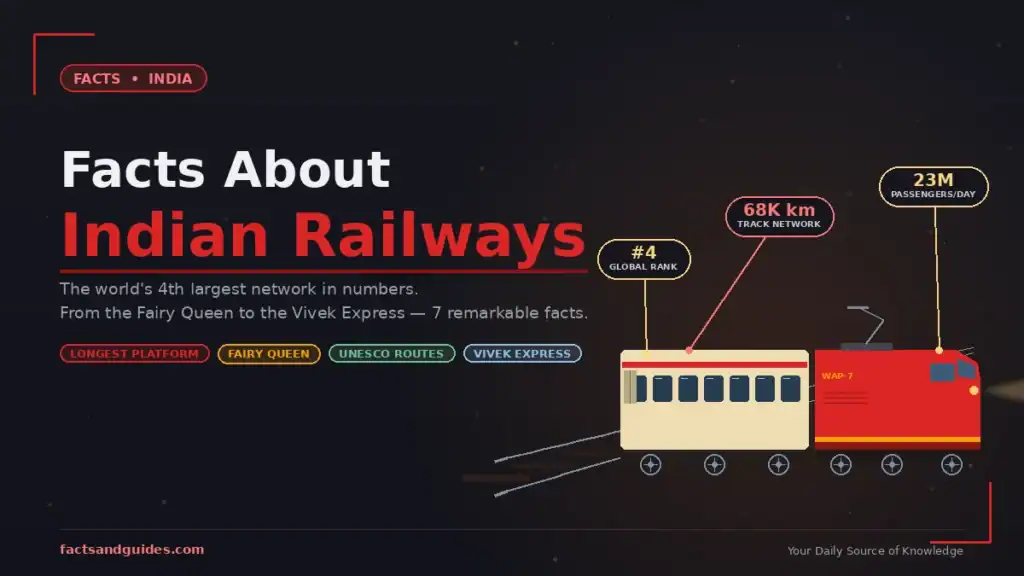
Passenger traffic reached an all-time high of 7.41 billion in FY2025–26, up 3.54% from the previous year. That is more than the entire population of Europe transported in a single year. On any given day, Indian Railways moves approximately 23 million passengers — roughly equivalent to the entire population of Australia.
Fact 2: 4th Largest Railway Network in the World
With over 68,000 kilometres of route length, Indian Railways operates the 4th largest railway network globally — after the United States, China, and Russia. The network connects more than 7,000 stations across 29 states and 8 union territories.
Fact 3: 1,670 Million Tonnes of Freight in a Single Year
Indian Railways set a new freight record in FY2025–26, transporting 1,670 million tonnes of goods — a 3.25% year-on-year increase. From coal and iron ore to cement, fertilisers, and foodgrains, the railway network is the backbone of India’s industrial supply chain.
Fact 4: One of the World’s Largest Employers — 1.3 Million People
Indian Railways employs approximately 1.3 million people as of 2026, making it one of the largest civilian employers on the planet. This workforce includes locomotive drivers, station masters, track maintenance engineers, catering staff, signal operators, and administrative personnel spread across the entire country.
| Indian Railways Statistic (FY2025–26) | Number |
|---|---|
| Total route length | 68,000+ km |
| Stations | 7,000+ |
| Daily passengers | ~23 million |
| Annual passengers (FY26) | 7.41 billion (record) |
| Annual freight (FY26) | 1,670 million tonnes (record) |
| Employees | ~1.3 million |
| Electric locomotives | 13,569 |
| Diesel locomotives | 4,169 |
| Passenger coaches | 91,948 |
| Freight wagons | 327,991 |
| Passenger revenue (FY26) | ₹80,000 crore |
| Global network rank | 4th (after US, China, Russia) |
Indian Railways History: From 1853 to 2026
The Indian Railways history spans over 170 years — from a single 33 km line to one of the world’s largest rail networks. These facts trace the journey.
Fact 5: The First Indian Train Ran on 16 April 1853
India’s railway journey began on 16 April 1853 when the first passenger train ran 33 kilometres from Bori Bunder (now Mumbai CSMT) to Thane. The train had 14 carriages carrying around 400 guests, pulled by three steam locomotives named Sultan, Sindh, and Sahib. The day was declared a public holiday to mark the historic occasion. This single event changed India forever — connecting cities, enabling trade, and unifying a vast subcontinent.
Fact 6: The First Railway Proposal Was Made in 1832
The idea of building a railway in India was first proposed in 1832 in Madras (now Chennai). In 1835, a small railway track was constructed between Red Hills and Chintadripet in Madras, becoming operational by 1837 — making it one of the earliest railway experiments in Asia, predating the famous 1853 Mumbai–Thane line by 16 years.
Fact 7: Indian Railways Was Nationalised in 1951
Before independence, India had about 42 different private railway companies operating approximately 55,000 km of track. After independence, these were gradually merged into a single entity. By 1951, Indian Railways was fully nationalised under government ownership, creating the unified system we know today. It is the largest rail network in Asia operated under a single management.
Fact 8: The First Female Railway Minister Presented the Railway Budget in 2000
Mamata Banerjee (current Chief Minister of West Bengal) became India’s first woman Railway Minister in 2000. She also became the first female railway minister to present the Railway Budget and holds the record of presenting the railway budget for two different central governments (NDA and UPA).
Indian Railways World Records: Guinness-Certified Achievements
Indian Railways holds several verified Indian Railways world records that are recognised internationally. These are some of the most interesting facts about Indian Railways that most people are unaware of.
Fact 9: World’s Longest Railway Platform — Gorakhpur (1,366 metres)
Gorakhpur Junction in Uttar Pradesh holds the Guinness World Record for the longest railway platform in the world, measuring 1,366.33 metres. The platform was extended to this length to accommodate the extremely long-distance trains that serve this station. Before Gorakhpur, the record was held by Kharagpur in West Bengal at 1,072 metres.
Fact 10: World’s Oldest Working Steam Locomotive — The Fairy Queen (1855)
Built in 1855 by the British firm Kitson, Thompson and Hewitson, the Fairy Queen is recognised by the Guinness Book of World Records as the oldest working steam locomotive on the planet. It operates a heritage run between Delhi and Alwar in Rajasthan and has received the Heritage Award from the International Tourist Bureau, Berlin.
Fact 11: World’s Highest Railway Bridge — Chenab Bridge (359 metres)
The Chenab Bridge in Jammu & Kashmir, part of the Udhampur–Srinagar–Baramulla Rail Link, stands 359 metres above the river — making it the world’s highest railway bridge. It is 35 metres taller than the Eiffel Tower and 5 times the height of the Qutub Minar. The bridge is designed to withstand earthquakes and high-speed winds, and it is an engineering marvel that took over a decade to complete.
Fact 12: The Longest Train Route — Vivek Express (4,273 km, ~80 Hours)
The Vivek Express, running from Dibrugarh in Assam to Kanyakumari in Tamil Nadu, covers approximately 4,273 kilometres over roughly 80 hours (more than 3 days), making it the longest train route in India. Named after Swami Vivekananda, it traverses the entire length of the country from the northeast to the southern tip.
Fact 13: New Delhi Railway Station Has the World’s Largest Route Relay Interlocking System
New Delhi Railway Station is listed in the Guinness Book of Records for having the world’s largest Route Relay Interlocking System — a complex signalling system used to safely manage train movements where multiple tracks intersect during periods of high traffic.
Interesting Facts About Indian Railways: Heritage & UNESCO Sites
Fact 14: 4 Indian Railway Sites Are UNESCO World Heritage Sites
Four sites of Indian Railways have been declared UNESCO World Heritage Sites — the most for any single railway system in the world:
- Darjeeling Himalayan Railway (inscribed 1999) — a narrow-gauge “Toy Train” reaching 2,200 metres using a remarkable zigzag and loop system
- Mumbai Chhatrapati Shivaji Maharaj Terminus (CSMT) (inscribed 2004) — the stunning Victorian Gothic station where India’s first train departed
- Nilgiri Mountain Railway (inscribed 2005) — a rack railway climbing through the Nilgiri Hills in Tamil Nadu
- Kalka-Shimla Railway (inscribed 2008) — climbing to 2,076 metres through 102 tunnels and over 800 bridges
Fact 15: The Kalka-Shimla Line Passes Through 102 Tunnels and 800+ Bridges
Built between 1898 and 1903, the Kalka-Shimla Railway covers 96 km through 102 tunnels, over 800 bridges, and 919 curves — an extraordinary engineering feat for its era. The line climbs from 656 metres at Kalka to 2,076 metres at Shimla, with the steepest gradient being 1 in 33.
Interesting Facts About Indian Railways: Food, Life & Culture
Fact 16: IRCTC Serves 15 Lakh Meals Per Day
The Indian Railway Catering and Tourism Corporation (IRCTC) serves an estimated 15 lakh (1.5 million) meals per day across trains and station platforms — making Indian Railways one of the largest catering operations on the planet. From regional thalis and biryani to packaged snacks and pantry car meals, the railway feeds a small country’s worth of people every single day.
Fact 17: Indian Railways Carries the Equivalent of Australia’s Population Daily
With approximately 23 million passengers daily, Indian Railways moves a number of people equivalent to the entire population of Australia every single day. During festival seasons like Diwali, Chhath Puja, and summer holidays, this number swells even further as special trains are added to meet demand.
Fact 18: The Indian Railways Network Would Circle the Earth 1.7 Times
At 68,000+ km of route length (and 115,000+ km of total track length including sidings and parallel tracks), the Indian Railways network laid end to end would circle the Earth approximately 1.7 times. The track covers every climate zone in India — from the scorching Thar Desert to the frozen heights of the Himalayas.
Indian Railways in 2026: Modernisation & Future
Fact 19: Vande Bharat Express — India’s Semi-High Speed Revolution
Launched in 2019, the Vande Bharat Express is India’s first indigenously designed and manufactured semi-high speed train, capable of reaching 180 km/h. The trains feature air-conditioned chair car seating, onboard Wi-Fi, GPS-based passenger information, automatic doors, and bio-vacuum toilets. As of 2026, multiple Vande Bharat routes are operational across India, with plans to expand to 75+ routes.
Fact 20: India’s First High-Speed Rail Line Is Under Construction
The Mumbai–Ahmedabad High-Speed Rail corridor (also called the Bullet Train project) is under construction and will become India’s first true high-speed rail line. Using Japanese Shinkansen technology, trains will operate at speeds up to 320 km/h, reducing the Mumbai–Ahmedabad travel time from 7+ hours to approximately 2 hours. The project is targeted for completion in phases from 2026 onwards.
Fact 21: Indian Railways Aims for Net-Zero Carbon Emissions by 2030
Indian Railways has set an ambitious target to become a net-zero carbon emitter by 2030. The strategy includes complete electrification of all rail routes (already above 90% as of 2026), installation of solar panels on station rooftops, replacement of diesel locomotives with electric ones, and the development of hydrogen fuel cell-powered trains for non-electrified routes.
Fact 22: Over 90% of Indian Railways Is Now Electrified
As of 2026, over 90% of India’s broad-gauge railway network has been electrified — up from just 40% a decade ago. Electric traction is more energy-efficient, produces zero direct emissions, and enables faster train speeds. India aims for 100% electrification within the next few years, completely eliminating diesel locomotives from the mainline network.
5 Quirky and Surprising Indian Railways Facts
- Fact 23: The slowest train averages just 10 km/h. The Mettupalayam–Ooty Nilgiri Passenger train climbs through the Nilgiri Hills at an average speed of just 10 km/h — making it the slowest train in India. You could walk faster, but the views are priceless.
- Fact 24: Indian Railways has 16 steam locomotives still in inventory. As of February 2026, Indian Railways still had 16 steam locomotives listed in its official inventory — relics of an era when steam powered the entire network. Most are preserved for heritage runs and museum displays.
- Fact 25: IRCTC is India’s largest e-commerce platform for travel. IRCTC.co.in handles over 20 lakh ticket bookings per day during peak season, making it one of the highest-traffic e-commerce websites in India — rivalling Amazon and Flipkart in daily transaction volumes during festival rushes.
- Bonus: Indian Railways operates its own police force. The Railway Protection Force (RPF) is a dedicated armed force responsible for the security of railway property and passengers across the entire network — essentially a separate police force just for the railways.
- Bonus: The Diamond Crossing at Nagpur is one of the few in the world. Nagpur Junction features a rare “diamond crossing” where two broad-gauge railway lines cross each other at right angles without any junction or switch — a rare engineering feature found in very few places globally.
Why These Facts About Indian Railways Matter
Indian Railways is more than infrastructure — it is a 170-year-old institution that stitches together the world’s most diverse nation. It carries students to exams, workers to factories, families to weddings, soldiers to borders, and pilgrims to temples. Understanding these facts about Indian Railways deepens our appreciation for a system that billions of Indians depend on every year — and that continues to evolve with Vande Bharat, electrification, and the upcoming bullet train.
Planning your first trip by train? Check out our First-Time Travel from India Checklist for more travel tips.