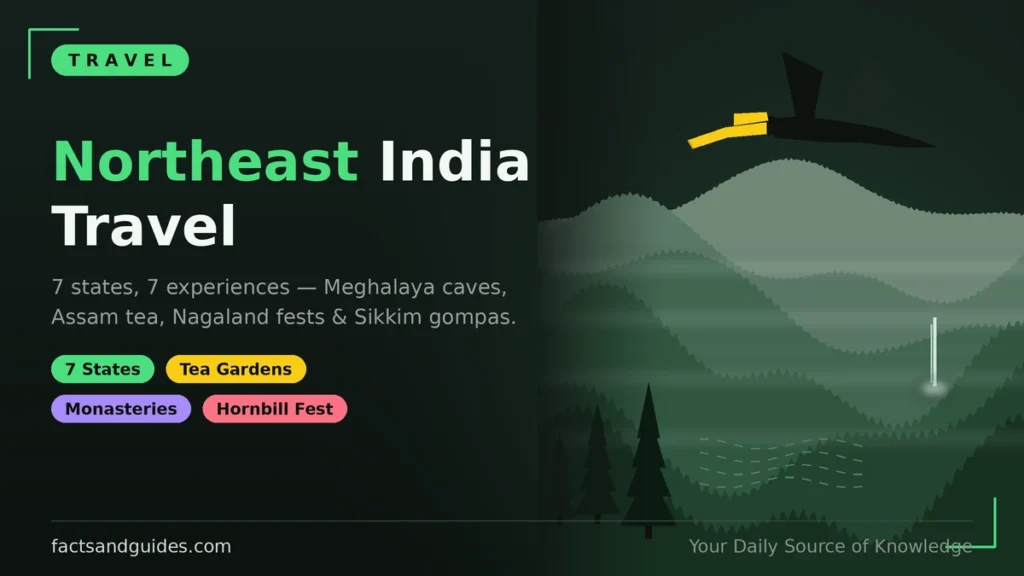
Northeast India travel is the closest thing the country has to a different world that still uses the rupee. Wedged between Bhutan, China, Myanmar and Bangladesh, and joined to the rest of India by a corridor barely 20 kilometres wide, this is a region of eight states where the food, faces, festivals and forests look almost nothing like the India most travellers know. You can hike to a living root bridge grown by hand over a century, watch a one-horned rhino graze at dawn, and wake to a view of the world’s third-highest mountain — all within one trip.
This guide does something specific: it takes seven of these states and pairs each one with a single, unmistakable experience worth planning a journey around. Along the way you will get the practical scaffolding that makes Northeast India travel work — which states need permits, when to go, how to get around, what it costs, and the mistakes that quietly ruin first trips. The aim is to help you plan a realistic route rather than an impossible bucket list.
- Northeast India is officially eight states: the seven “sister” states (Arunachal Pradesh, Assam, Manipur, Meghalaya, Mizoram, Nagaland, Tripura) plus Sikkim. This guide features seven of them. Indian citizens need an Inner Line Permit (ILP) for Arunachal Pradesh, Nagaland, Mizoram and Manipur — but no permit at all for Assam, Meghalaya or Tripura. The best time to visit Northeast India is October to April, when the rain eases and the big parks and passes open. Guwahati is the main air gateway; new airports at Itanagar (Donyi Polo) and Sikkim’s Pakyong have shortened old road routes. One realistic trip covers two or three neighbouring states well — not all eight. The Hornbill Festival runs 1–10 December 2026 in Nagaland, and is the single best week to see Northeast culture in one place.
Northeast India Travel at a Glance: The Seven States
Before you fall for any single photograph, it helps to see how the states line up. Each one has a different “headline” experience, a different season that suits it best, and different paperwork. The table below is the map of this entire guide — read it once, and the rest of your Northeast India travel planning becomes a question of picking two or three rows that sit next to each other.
| State | Signature experience | Best season | Permit for Indians | Nearest airport |
|---|---|---|---|---|
| Meghalaya | Living root bridges & Dawki’s clear river | Oct–Apr (Sep for waterfalls) | None | Guwahati (GAU) |
| Assam | Kaziranga rhinos & endless tea gardens | Nov–Apr (park closed in monsoon) | None | Guwahati / Jorhat / Dibrugarh |
| Arunachal Pradesh | Tawang Monastery & high Himalaya | Oct–Apr | ILP required | Donyi Polo, Itanagar (HGI) |
| Nagaland | Hornbill Festival (1–10 Dec) | December for the festival | ILP required | Dimapur (DMU) |
| Sikkim | Monasteries & Kanchenjunga views | Mar–May, Oct–Dec | None for towns; PAP for border zones | Bagdogra (IXB) / Pakyong (PYG) |
| Mizoram | Blue hills & the Chapchar Kut festival | Oct–Mar | ILP required | Lengpui, Aizawl (AJL) |
| Manipur | Loktak Lake’s floating islands | Oct–Mar | ILP required | Imphal (IMF) |
One honest note on the “7 states” framing: the seventh sister, Tripura — known for the Ujjayanta Palace and the rock carvings at Unakoti — is the one state this guide does not give a full section to, simply because most first trips orbit the six states above plus Sikkim. If you have been to the others, Tripura is a quiet, rewarding addition.
Best Time to Visit Northeast India
If you take only one planning decision from this guide, make it the timing. The best time to visit Northeast India is broadly October to April, the dry window when roads hold, skies clear and the headline sights are open. The region’s rain is not a detail — Cherrapunji and Mawsynram in Meghalaya are among the wettest inhabited places on earth, and the monsoon from June to September can wash out the very roads you need.
That said, “best” depends on what you came for. The table below breaks the year into honest seasons so your Northeast India travel dates match your goal rather than a generic recommendation.
| Season | Months | What it’s good for | What to watch |
|---|---|---|---|
| Post-monsoon | Oct–Nov | Green hills, clear views, festivals begin, Kaziranga reopens | Books up fast around festivals |
| Winter | Dec–Feb | Hornbill Festival, dry roads, best wildlife sightings | Cold nights; high passes may have snow |
| Spring | Mar–Apr | Rhododendrons, Sikkim & Arunachal at their best, tea flush begins | Haze building by late April |
| Monsoon | May–Sep | Waterfalls in full roar, fewest crowds, lowest prices | Landslides, road closures, parks shut |
7 Unique Places to Visit in Northeast India
Here is the heart of the guide: seven states, seven experiences. Each of these places to visit in Northeast India is something you cannot do anywhere else in the country, which is exactly why it earns a spot on the list. Read these as standalone anchors — you choose two or three, then build a route around them rather than trying to tick every one.
Meghalaya — Living Root Bridges and the Wettest Place on Earth
Meghalaya is the easiest state to fall for and the easiest to reach, sitting just a few hours by road from Guwahati. Its signature experience is the jingkieng jri, the living root bridges of the Khasi and Jaintia hills — handrails and walkways grown over decades by training the aerial roots of rubber fig trees across streams. The double-decker bridge at Nongriat, below Cherrapunji (Sohra), is the famous one, reached by a steep descent of roughly 3,000 steps. These bridges have been on UNESCO’s World Heritage tentative list since 2022.
Beyond the bridges, Meghalaya gives you Mawlynnong (often called the cleanest village in Asia), the glass-clear Umngot river at Dawki where boats appear to float on air, and Shillong’s easygoing café-and-music culture. Crucially for planning, Indian citizens need no permit at all to travel in Meghalaya.
Assam — Kaziranga Rhinos and Endless Tea Gardens
Assam is the flat heart of the region, the Brahmaputra valley that almost everyone passes through. Its signature experience is Kaziranga National Park, a UNESCO World Heritage Site that holds the world’s largest population of the greater one-horned rhinoceros. A jeep or elephant safari here, with the river mist still hanging over the grassland, is one of the great wildlife mornings in Asia. Kaziranga is typically open from November to April and closes during the monsoon when the park floods.
Assam’s second act is tea. The state produces a large share of India’s tea, and a stay on a working tea estate near Jorhat or Dibrugarh — colonial bungalows, mist, and endless green rows — is a gentler companion to the safari. Add Majuli, one of the world’s largest river islands and the home of Assam’s neo-Vaishnavite satras (monastic centres), and Assam alone justifies a week. No permit is needed for Indians.
Arunachal Pradesh — Tawang Monastery and the High Himalaya
Arunachal Pradesh is the wild, vertical frontier — India’s easternmost and least-visited large state, where the first sunrise in the country lands. Its signature experience is Tawang, in the far north-west near the Bhutan border: a 17th-century Buddhist monastery that is the largest in India, perched at over 3,000 metres with snow peaks behind it. Getting there means a long, spectacular drive over the Sela Pass, which is itself part of the experience.
The state rewards slow Northeast India travel — the Ziro valley of the Apatani people (on UNESCO’s tentative list and home to the September Ziro Festival of Music), the meadows of Mechuka, and tribal cultures that differ from one valley to the next. Itanagar now has its own airport, Donyi Polo (opened November 2022), with IndiGo flights to Delhi, Kolkata and other metros, which has cut hours off the old road approach.
Nagaland — The Hornbill Festival
Nagaland’s signature experience has a fixed date. The Hornbill Festival runs from 1 to 10 December 2026 at Kisama Heritage Village, about 12 kilometres from the capital Kohima, and 2026 marks the festival’s 25th year. Often called the “Festival of Festivals,” it gathers Nagaland’s major tribes into one place, each with its own morung (traditional dormitory), for ten days of war dances, log-drum rituals, folk music, indigenous games, crafts and food. Daily entry is modest, roughly ₹50–₹100.
If you can only witness one thing in the entire region, this is a strong candidate, because it compresses the cultural diversity of the whole Northeast into a single walkable site. The nearest airport and railhead is Dimapur, about 74 kilometres from Kohima. Beyond the festival, Nagaland offers the Dzukou valley trek and, for the adventurous, the Konyak villages of Mon near the Myanmar border.
Sikkim — Monasteries and Kanchenjunga Views
Sikkim is the polished, organised exception in the Northeast — clean, calm and astonishingly scenic. Its signature experience is the combination of Buddhist monasteries and the constant presence of Kanchenjunga, the world’s third-highest mountain at 8,586 metres, visible from Pelling, Gangtok and a dozen ridgelines between. Rumtek and Pemayangtse monasteries, the old capital of Yuksom, and the sacred Tsomgo Lake form a classic loop.
Sikkim earned a separate kind of fame as India’s first fully organic state, a status recognised internationally with the FAO’s Future Policy Gold Award in 2018. For Northeast India travel logistics, Sikkim is reached via Bagdogra airport (IXB) or the New Jalpaiguri railhead in West Bengal, both a four-to-five-hour drive from Gangtok; the state’s own Pakyong airport (PYG) operates weather permitting.
Mizoram and Manipur — Blue Hills and a Floating Lake
Two states round out the seven, both deeply offbeat. Mizoram is a quiet land of blue, folded hills and one of India’s highest literacy rates; its Chapchar Kut spring festival and the bamboo-dance traditions of Aizawl reward travellers who want culture without crowds. Manipur’s signature experience is Loktak Lake, the largest freshwater lake in the Northeast, famous for its phumdis — floating islands of vegetation. One of them holds Keibul Lamjao, the only floating national park in the world and the last refuge of the endangered sangai (brow-antlered deer).
Both states require an Inner Line Permit for Indian citizens, and both reward travellers who treat them as the second or third leg of a longer Northeast India trip rather than a quick stop. Imphal and Aizawl (Lengpui) both have airports with regular connections via Guwahati and Kolkata.
Permits, Flights and Getting Around: Planning Your Northeast India Travel
This is where most first trips succeed or stumble. The single biggest source of confusion in Northeast India travel is the assumption that the whole region follows one rule. It does not — three states are permit-free for Indians, four need an Inner Line Permit, and Sikkim sits in between. Get this right and almost everything else falls into place.
For Indian citizens, the Inner Line Permit (ILP) is required for Arunachal Pradesh, Nagaland, Mizoram and Manipur (Manipur was added in 2019). It is an online, low-cost document, usually valid for around 15 days and extendable, that you should apply for on the relevant state portal a few days before you travel. Foreign nationals need a Protected Area Permit (PAP) instead, generally arranged through a registered tour operator. The table below summarises who needs what.
| State | Indian citizens | How to apply | Foreign nationals |
|---|---|---|---|
| Assam, Meghalaya, Tripura | No permit | — | No permit |
| Arunachal Pradesh | ILP required | eilp.arunachal.gov.in (online) | PAP via tour operator |
| Nagaland | ILP required | ilp.nagaland.gov.in (online) | PAP (often relaxed at Hornbill) |
| Mizoram | ILP required | State portal / entry gate | PAP via tour operator |
| Manipur | ILP required (since 2019) | Manipur ILP portal | PAP via tour operator |
| Sikkim | None for towns; PAP for North/East border zones | Tour operator / e-FRRO (digital since Jan 2026) | RAP via e-FRRO, then zone PAPs |
On flights: Guwahati’s Lokpriya Gopinath Bordoloi airport (GAU) is the undisputed gateway, handling the bulk of the region’s traffic with direct links to Delhi, Mumbai, Kolkata, Bengaluru and more. From there you fan out — to Imphal, Dibrugarh, Jorhat, Silchar, Agartala, Aizawl, Dimapur, and the newer airports at Itanagar (Donyi Polo, 2022) and Sikkim’s Pakyong. The Northeast has expanded from nine airports in 2013 to seventeen today, which is the quiet revolution that has made independent Northeast India travel realistic for ordinary travellers.
On the ground, plan for shared sumos and jeeps, hired cars with local drivers, and slow mountain roads. Distances on the map lie — a 150-kilometre hill drive can take six hours. The table below shows the practical ways to reach each anchor.
| Destination | Fly to | Then | Rough road time |
|---|---|---|---|
| Shillong / Cherrapunji (Meghalaya) | Guwahati | Shared taxi or hired car | 3–4 hrs to Shillong |
| Kaziranga (Assam) | Jorhat or Guwahati | Hired car | 1.5 hrs (Jorhat) / 5 hrs (Guwahati) |
| Tawang (Arunachal) | Guwahati or Tezpur | 2-day drive via Bomdila & Sela Pass | 10–12 hrs total |
| Kohima / Hornbill (Nagaland) | Dimapur | Shared taxi to Kohima | 2.5–3 hrs |
| Gangtok (Sikkim) | Bagdogra or Pakyong | Shared sumo or hired car | 4–5 hrs from Bagdogra |
Building a Northeast India Itinerary
The most common mistake — covered properly in the next section — is trying to see everything. A realistic Northeast India itinerary picks one cluster of neighbouring states and goes deep. Because the region splits naturally into a western Himalayan side (Sikkim, then Arunachal) and a central-eastern hill-and-valley side (Meghalaya, Assam, Nagaland), most good routes stay on one side per trip.
Below are three field-tested shapes for a Northeast India itinerary, sorted by how much time you have. Treat the day counts as minimums; add a buffer day for the weather, which has the final say in the mountains.
| Itinerary | Days | Route | Best for |
|---|---|---|---|
| Meghalaya–Assam loop | 7 | Guwahati → Shillong → Cherrapunji → Dawki → Kaziranga → Guwahati | First-timers, no permits, easy roads |
| Hornbill culture trip | 8–9 | Dimapur → Kohima (Hornbill) → Khonoma → Dzukou → Kaziranga | December festival travellers |
| Sikkim Himalaya | 7–8 | Bagdogra → Gangtok → Tsomgo/Nathula → Lachung/Yumthang → Pelling | Mountains, monasteries, families |
| Arunachal frontier | 9–10 | Guwahati → Dirang → Tawang → Bomdila → Ziro → Itanagar | Adventurous, slow, high-altitude travel |
What about the famous “all 7 states in 14 days” route you will see advertised? It exists, and it can be done, but it is mostly movement — long drives, short stops, little depth. If your goal is to feel the place rather than photograph a checklist, two clusters across two separate trips will serve you far better than one breathless fortnight.
Common Mistakes in Northeast India Travel
Almost every disappointing trip to the region traces back to one of a handful of avoidable errors. Read this list before you book anything — it is the cheapest insurance you will buy. These are the recurring mistakes that derail Northeast India travel, in rough order of how often they bite.
1. Assuming one permit rule fits all. Three states need nothing, four need an ILP, Sikkim is split. Check each state on your route separately.
2. Trying to cover all eight states in one trip. It turns a holiday into a road marathon. Pick a cluster and go deep.
3. Carrying only a phone copy of your permit. Checkpoint officers may refuse digital copies — always print your ILP and keep your ID name matching exactly.
4. Booking flights before checking the season. Kaziranga is shut in the monsoon and high passes can be snowbound; confirm the sight is open before you lock in dates.
5. Leaving festival stays to the last minute. Hornbill accommodation around Kohima vanishes weeks ahead and prices climb steeply.
6. Underestimating road times. Hill roads run at 20–30 km/h. A “short” 150-km hop can eat an entire day.
7. Ignoring altitude. Tawang, Nathula and North Sikkim sit above 3,000 metres — ascend gradually, hydrate, and don’t sprint on day one.
8. Running out of cash. ATMs are sparse and unreliable in the hills, and mobile signal drops out. Carry more cash than you think you need.
9. Treating sacred and tribal spaces as photo backdrops. Ask before photographing people, monasteries and rituals; many communities have firm preferences.
10. Skipping travel insurance and a buffer day. Weather closes roads without notice; a spare day and decent cover save the trip when it does.