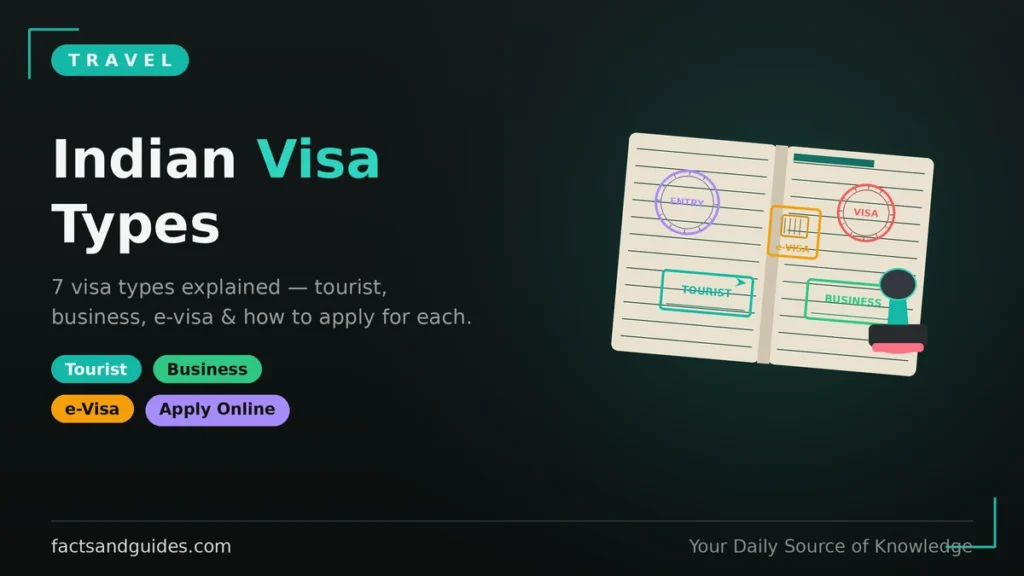
Understanding the main Indian visa types is the first step for almost any foreign national planning a trip to India, because the country issues a different visa for almost every purpose — tourism, business, study, work, medical treatment and more. Pick the wrong category and your application can be delayed or rejected; pick the right one and, for most travellers, the whole process is now a quick online affair. The key is matching your reason for visiting to the correct visa from the start.
This guide explains the seven main Indian visa types in plain language — who each is for, how long it lasts, and how to apply — along with the documents, fees and common mistakes that trip people up. Most tourists and business visitors today use the convenient e-Visa, while work, study and longer stays need a regular visa. Whatever your purpose, here is how the system works in 2026.
- India issues a separate visa for each purpose — the seven main Indian visa types are e-Visa, tourist, business, employment, student and medical (with attendant) and conference. Most tourists and business visitors use the online e-Visa; employment, journalism and NGO work need a regular (sticker) visa. Apply only on the official portal, indianvisaonline.gov.in — many look-alike sites charge extra fees for nothing. Your passport must be valid for at least six months from arrival, with two blank pages. e-Tourist visas come in 30-day, one-year and five-year options; the e-Visa is typically processed in around 72 hours. Fees vary by nationality and visa type, so always check the official fee calculator before paying.
Indian Visa Types at a Glance
Before the detail, here is the map. The table below summarises the seven main Indian visa types, who each suits, and whether you can get it online as an e-Visa or must apply for a regular sticker visa. Find your purpose, then read that section below.
| Visa type | For | Online e-Visa? |
|---|---|---|
| e-Visa | Tourism, business, medical, conference (online route) | Yes |
| Tourist Visa | Sightseeing, family visits, yoga, leisure | e-Tourist or regular |
| Business Visa | Meetings, trade, setting up ventures | e-Business or regular |
| Employment Visa | Skilled professionals working in India | No — regular only |
| Student Visa | Study at recognised institutions | e-Student or regular |
| Medical (+ Attendant) | Treatment, plus up to 2 attendants | e-Medical or regular |
| Conference Visa | Government-approved conferences | e-Conference or regular |
The 7 Main Indian Visa Types Explained
Here are the seven main Indian visa types in detail. Note that the e-Visa is really an online application route that covers several purposes (tourist, business, medical, conference and more), while a few categories — notably employment — are only available as a regular visa.
1. The Indian e-Visa
The Indian e-Visa is an Electronic Travel Authorisation applied for entirely online, with sub-categories for tourism, business, medical treatment, medical attendants, Ayush (Indian systems of medicine) and conferences. Available to citizens of a large list of eligible countries, it is the fastest and simplest option for most visitors, usually processed in about 72 hours, with entry through designated airports and seaports. It is not available for employment, journalism or NGO work, nor to diplomatic passport holders.
2. Indian Tourist Visa
The Indian tourist visa is for recreation, sightseeing, visiting friends and relatives, short yoga programmes and similar leisure purposes. The e-Tourist version comes in three flavours — 30 days (double entry), one year and five years (multiple entry) — while regular tourist visas of up to five or ten years are available to some nationalities. A maximum stay per visit applies, so check the limit for your passport.
3. Business Visa
The business visa covers meetings, trade, industrial visits, client interactions and setting up ventures — but not taking up employment. The e-Business visa is valid for a year with multiple entries, each stay capped at 180 days; longer stays require registration with the FRRO. For extended or complex business needs, a regular business visa of up to five years may suit better.
4. Employment Visa
The employment visa is for skilled and qualified professionals taking up a salaried role with an Indian organisation, and it is one category you cannot get as an e-Visa — you must apply for a regular visa. It typically requires a minimum salary threshold and a contract or appointment letter, and is granted for the term of employment or one year, renewable in India.
5. Student Visa
The student visa is for foreign nationals enrolled in a recognised Indian educational institution, granted for the duration of the course (up to five years). An e-Student option now exists for eligible applicants, and dependants can apply for an associated visa. Proof of admission to the institution is the core requirement.
6. Medical and Medical Attendant Visa
India is a major medical-tourism destination, and the medical visa is for patients seeking treatment at recognised hospitals, including under Indian systems of medicine (Ayush). The e-Medical visa is valid for 60 days with triple entry; a linked medical attendant visa lets up to two family members accompany the patient. A letter from the Indian hospital supports the application.
7. Conference Visa
The conference visa is for attending conferences, seminars or workshops organised by a government ministry, department or approved body. The e-Conference version is valid for 30 days with single entry, and holders may also do limited tourist activities within that window. An invitation and political/event clearance from the organisers is usually needed.
How to Apply for an Indian Visa
There are two routes, and which one you use depends on your visa type. Knowing how to apply for an Indian visa correctly saves both time and money. The e-Visa is fully online; regular (sticker) visas require an in-person step at an Indian Visa Application Centre (IVAC).
| Step | e-Visa (online) | Regular / sticker visa |
|---|---|---|
| 1. Apply | Fill the form at indianvisaonline.gov.in | Fill the online form, then book IVAC slot |
| 2. Upload/submit | Photo + passport page online | Documents + biometrics at IVAC |
| 3. Pay | Online; fee by nationality | Online or at centre |
| 4. Receive | ETA by email (~72 hrs) | Visa stamped in passport |
| 5. Enter India | Designated airports/seaports | Any authorised port |
For an e-Visa, apply between roughly 30 days and 4 days before travel, carry a printout of your approved ETA, and travel on the same passport you applied with. For a regular visa, apply well ahead, as biometrics appointments and processing take longer.
Indian Visa Fees, Validity and Documents
Indian visa fees vary by nationality, visa type and duration, and are paid online during the application — so the official fee calculator is the only reliable source for your exact amount. Validity ranges from 30 days to several years depending on the category, as summarised below.
| Visa | Typical validity | Entry |
|---|---|---|
| e-Tourist | 30 days / 1 year / 5 years | Double or multiple |
| e-Business | 1 year | Multiple (≤180 days/stay) |
| e-Medical | 60 days | Triple |
| e-Conference | 30 days | Single |
| Regular tourist/business | Up to 5–10 years | Multiple (nationality-based) |
Across all Indian visa types, the core documents are similar: a passport valid for at least six months from arrival with two blank pages, a recent photograph, and proof supporting your purpose. The checklist below covers the essentials.
| Document | Notes |
|---|---|
| Passport | 6+ months validity, 2 blank pages |
| Photograph | Recent, as per specifications |
| Return/onward ticket | Plus proof of funds |
| Purpose proof | Hotel/invite, admission, hospital or employer letter |
| Passport bio page scan | For online upload |
Common Mistakes with Indian Visa Types
Most visa problems come from a handful of avoidable errors. Avoid these and your application should go through smoothly.
1. Choosing the wrong category. Match the visa to your main purpose; using a tourist visa for work or journalism is a serious violation.
2. Using a fake website. Apply only on indianvisaonline.gov.in; look-alike sites overcharge or scam.
3. Ignoring passport validity. You need six months from arrival and two blank pages, or you may be refused boarding.
4. Applying for e-Visa when ineligible. Employment, journalism, NGO work and some nationalities require a regular visa.
5. Travelling on a different passport. You must enter on the same passport used for the e-Visa application.
6. Mistiming the application. Apply within the e-Visa window (about 30 to 4 days before travel), or earlier for sticker visas.
7. Overstaying the per-visit limit. Watch the maximum stay and register with the FRRO if you exceed 180 days.
8. Entering at the wrong port. e-Visa holders must arrive at designated airports and seaports.
9. Weak purpose documentation. Carry hotel bookings, invitations, admission or hospital letters as relevant.
10. Assuming visa-free entry. Only a few nationalities get visa-on-arrival; most need a visa in advance.