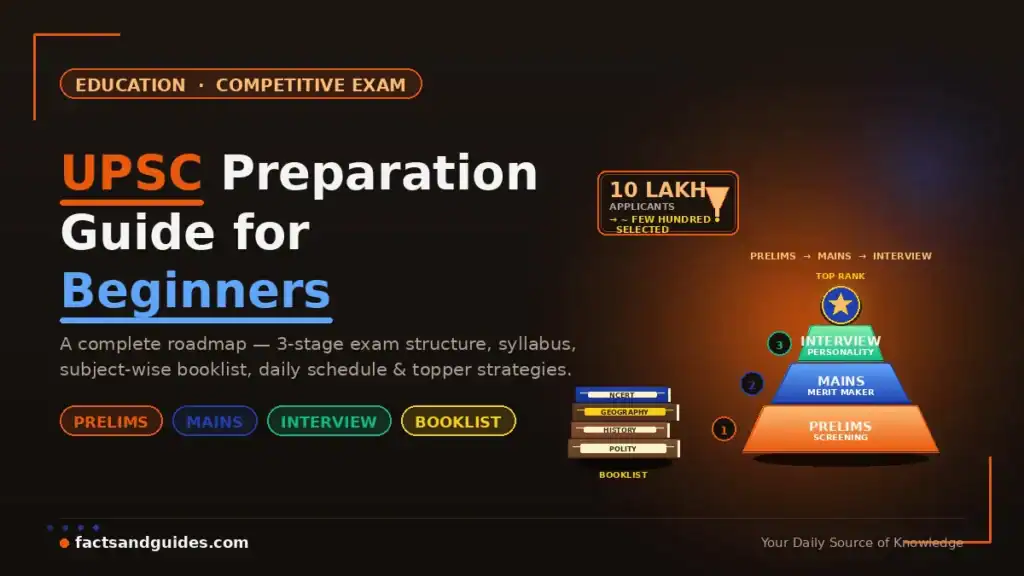
The UPSC Civil Services Examination is one of the most challenging and prestigious competitive exams in India. With over 10 lakh aspirants competing for approximately 933 vacancies in 2026, a structured and strategic approach is the difference between clearing and failing. Yet every year, thousands of ordinary Indians — from small towns, vernacular backgrounds, and non-coaching environments — clear this exam through disciplined, consistent effort.
This UPSC preparation guide gives beginners a clear, no-nonsense roadmap — covering the 3-stage exam structure, complete syllabus, subject-wise booklist, eligibility criteria, a realistic daily study schedule, Prelims and Mains strategy, and the 10 most common mistakes that aspirants make. If you are starting from zero, this guide is your starting point.
- UPSC CSE has 3 stages: Prelims (screening) → Mains (merit) → Interview (personality) Prelims 2026: 24 May 2026 | Mains 2026: 21 August 2026 | Vacancies: ~933 Eligibility: Age 21–32 (General), Bachelor’s degree, 6 attempts (General) Start with NCERT textbooks (Class 6–12) before touching any reference book One book per subject + multiple revisions beats multiple books with one reading Daily schedule: 6–8 hours — 40% static subjects, 30% current affairs, 30% answer writing
UPSC Eligibility and Attempts: Who Can Apply?
Before starting preparation, verify your UPSC eligibility and attempts. These criteria are non-negotiable — misunderstanding them can waste years of effort.
| Criteria | Requirement |
|---|---|
| Nationality | Indian citizen (IAS/IPS require Indian citizenship; other services allow certain eligible nationalities) |
| Age (as on 1 Aug 2026) | Minimum 21 years, Maximum 32 years (General/EWS) |
| Age Relaxation | OBC: +3 years (max 35) | SC/ST: +5 years (max 37) | PwBD: +10 years | Ex-servicemen: +5 years |
| Education | Bachelor’s degree from a recognised university (any subject, no minimum percentage). Final-year students can apply provisionally. |
| Attempts — General/EWS | 6 attempts |
| Attempts — OBC | 9 attempts |
| Attempts — SC/ST | Unlimited (within age limit) |
| What counts as an attempt | Appearing in even ONE paper of Prelims = 1 attempt consumed |
UPSC Syllabus and Exam Pattern: The 3-Stage Structure
Understanding the UPSC syllabus and exam pattern is the first step of any UPSC preparation guide. The exam has three sequential stages — you must clear each to proceed to the next.
Stage 1: Preliminary Examination (Prelims) — Screening Test
The Prelims is an objective-type (MCQ) screening test. It does NOT count towards your final merit — its sole purpose is to shortlist candidates for Mains. It has two papers:
| Paper | Subject | Marks | Duration | Nature |
|---|---|---|---|---|
| Paper I | General Studies (GS) | 200 | 2 hours | Merit-based — your score determines Prelims cutoff |
| Paper II | CSAT (Aptitude) | 200 | 2 hours | Qualifying only — need 33% (66 marks) to pass |
Negative marking: 1/3rd of marks deducted for each wrong answer. Do not guess randomly.
Prelims GS Paper I covers: Current affairs, Indian history, geography, Indian polity and governance, economic and social development, environment and ecology, general science.
Stage 2: Main Examination (Mains) — The Merit Maker
The Mains is a descriptive written exam consisting of 9 papers. This is where your final rank is primarily determined. Strong answer writing skills are essential.
| Paper | Subject | Marks | Nature |
|---|---|---|---|
| Paper A | Indian Language (qualifying) | 300 | Qualifying (not counted in merit) |
| Paper B | English (qualifying) | 300 | Qualifying (not counted in merit) |
| Paper I | Essay | 250 | Counted in merit |
| Paper II | GS-I: Indian Heritage, History, Geography, Society | 250 | Counted in merit |
| Paper III | GS-II: Governance, Polity, Constitution, Social Justice, International Relations | 250 | Counted in merit |
| Paper IV | GS-III: Economy, Technology, Environment, Disaster Management, Security | 250 | Counted in merit |
| Paper V | GS-IV: Ethics, Integrity, Aptitude | 250 | Counted in merit |
| Paper VI & VII | Optional Subject (2 papers) | 250 × 2 = 500 | Counted in merit |
Total Mains marks counted in merit: 1,750
Stage 3: Personality Test (Interview) — 275 Marks
Candidates who clear Mains appear before a UPSC board for a 30–45 minute conversation assessing personality, communication, clarity of thought, and suitability for civil services. Final merit = Mains marks (1,750) + Interview marks (275) = 2,025 total.
How to Prepare for UPSC Beginners: Step-by-Step Roadmap
If you are wondering how to prepare for UPSC beginners, follow this proven sequence that toppers and mentors consistently recommend.
Step 1: Read the Official UPSC Syllabus (Print It, Pin It)
Download the official UPSC syllabus from upsc.gov.in. Print it. Pin it on your study wall. Every study session should connect back to a syllabus topic. The syllabus is your roadmap — never deviate from it.
Step 2: Build Your Foundation with NCERTs (Class 6–12)
Before touching any reference book, read NCERT textbooks from classes 6 through 12 in these subjects: History, Geography, Political Science, Economics, Science, and Sociology. NCERTs provide the conceptual clarity that advanced books assume you already have. Read them thoroughly, make notes, and revise them at least twice.
Step 3: Move to Standard Reference Books (One Per Subject)
After completing NCERTs, pick ONE standard reference book per subject. Do NOT collect multiple books — depth and revision beat breadth every time.
Step 4: Start Newspaper Reading from Day 1
Read The Hindu or The Indian Express daily — cover the editorial, national news, international affairs, economy, and science sections. Make short notes of important developments. This habit takes 45–60 minutes daily and directly feeds both Prelims and Mains.
Step 5: Start Answer Writing Practice Early (Do NOT Delay This)
Answer writing is the most neglected and most important aspect of UPSC preparation. Start writing 2–3 answers daily from Month 3 onwards. Use previous year question papers (PYQs) as practice questions. Get them evaluated — by a mentor, peer group, or online platforms.
Step 6: Join a Prelims Test Series by Month 6
Mock tests simulate exam conditions, identify weak areas, and build time management skills. Join a reputed Prelims test series (Drishti IAS, Vision IAS, Vajiram & Ravi, or Forum IAS) and attempt at least 30–40 full-length tests before the actual exam.
UPSC Booklist 2026: Subject-Wise Recommended Books
The right UPSC booklist 2026 is one of the most critical decisions in your preparation. The rule is simple: one standard book per subject + NCERTs + newspaper = sufficient. Multiple revisions of limited resources beat one reading of many books.
| Subject | NCERT (Foundation) | Standard Reference Book |
|---|---|---|
| Indian Polity | Class 11 Political Science | Indian Polity — M. Laxmikanth |
| Modern Indian History | Class 12 History | Spectrum’s Brief History of Modern India — Rajiv Ahir |
| Ancient & Medieval History | Class 6–12 History NCERTs | Tamil Nadu Board History textbooks (Class 11–12) |
| Indian Geography | Class 6–12 Geography NCERTs | Certificate Physical & Human Geography — G.C. Leong |
| Indian Economy | Class 11–12 Economics | Indian Economy — Ramesh Singh |
| Environment & Ecology | Class 12 Biology (Ecology chapters) | Shankar IAS Environment booklet |
| Art & Culture | Class 11 Fine Arts NCERT | Indian Art & Culture — Nitin Singhania |
| Science & Technology | Class 6–10 Science NCERTs | Science & Technology by TMH / current affairs magazines |
| Ethics (GS-IV) | — | Ethics, Integrity & Aptitude — Lexicon / G. Subba Rao |
| Current Affairs | — | The Hindu / Indian Express daily + monthly compilations (Drishti / Vision) |
Daily Study Schedule for UPSC Preparation
Aim for 6–8 hours of focused study daily. Quality always beats quantity — four focused hours are more productive than eight distracted ones.
| Time Block | Activity | Duration | % of Total |
|---|---|---|---|
| Morning (6–7:30 AM) | Newspaper reading + notes (The Hindu / Indian Express) | 1.5 hours | — |
| Morning (8–11 AM) | Static subject study (Polity / History / Geography / Economy — rotate daily) | 3 hours | 40% |
| Afternoon (12–1:30 PM) | Current affairs revision + monthly magazine | 1.5 hours | 20% |
| Afternoon (3–5 PM) | Answer writing practice (2–3 Mains answers) OR Prelims MCQ practice | 2 hours | 30% |
| Evening (6–7 PM) | Revision of the day’s study + quick notes review | 1 hour | 10% |
| Total | ~8 hours |
10 Common UPSC Preparation Mistakes to Avoid
1. Collecting Too Many Books
One standard book per subject + NCERTs + newspaper is enough. Multiple revisions of limited resources always beat one reading of many books.
2. Skipping NCERTs
NCERTs are the foundation. Every topper starts here. Do NOT jump to advanced books without completing NCERTs from Class 6–12.
3. Ignoring Answer Writing Until Mains
This is the #1 reason capable aspirants fail Mains. Start answer writing practice by Month 3 of your preparation — not after Prelims results.
4. Over-Focusing on Prelims at the Cost of Mains
Prelims is a screening test — it does not count in your final rank. Mains + Interview determine your service. Balance your preparation across all stages.
5. Not Reading the Newspaper Daily
Current affairs account for 30–40% of both Prelims and Mains questions. Skipping the newspaper even for a week creates gaps that are hard to fill later.
6. Choosing the Wrong Optional Subject
Your optional subject carries 500 marks (25% of total Mains marks). Choose based on genuine interest, availability of study material, and past year results — not peer pressure or trends.
7. Not Solving Previous Year Questions (PYQs)
PYQs from the last 10–15 years reveal UPSC’s question patterns, difficulty level, and focus areas. Solve them systematically alongside your preparation.
8. Studying Without a Timetable
Unstructured preparation leads to topic imbalance. Create a weekly timetable covering all GS subjects, current affairs, and answer writing — and stick to it.
9. Comparing Yourself to Others
UPSC is a long journey. Comparing your progress with coaching institute toppers, online influencers, or peers creates unnecessary anxiety. Focus on your own improvement curve.
10. Neglecting Physical and Mental Health
UPSC preparation can last 1–3 years. Exercise regularly, sleep 7–8 hours, maintain social connections, and take breaks. A burnt-out mind cannot perform at its best on exam day.
UPSC CSE 2026: Important Dates
| Event | Date |
|---|---|
| Notification Released | 4 February 2026 |
| Preliminary Examination | 24 May 2026 |
| Main Examination | 21 August 2026 (5 days) |
| Interview / Personality Test | To be announced after Mains results |
| Total Vacancies | ~933 (including 33 PwBD) |
For free learning resources to supplement your preparation, check our guide on Best Free Online Learning Platforms in India. Understanding government schemes is also essential for GS-II — read our 15 Government Schemes Every Indian Should Know.