The Indian government runs over 300 central welfare schemes — covering health, housing, agriculture, education, pensions, loans, insurance, and savings. Yet most eligible Indians are either unaware of these programmes or do not know how to access them. Crores of rupees in benefits go unclaimed every year simply because people do not know they qualify.
This guide lists the 15 most important government schemes every Indian should know in 2026 — organised by category, with clear eligibility criteria, key benefits, and step-by-step instructions on how to apply for government schemes online. Whether you are a farmer, a salaried professional, a student, a parent, or a senior citizen, there is at least one scheme here that applies to you.
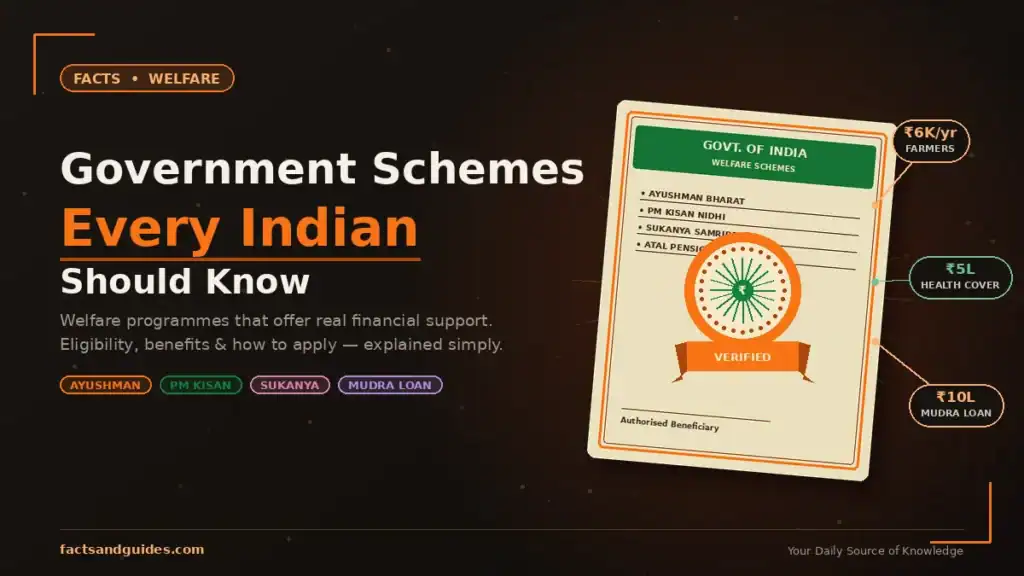
- Ayushman Bharat provides free health cover of ₹5 lakh/year to 12+ crore families PM Kisan gives ₹6,000/year directly to farmer bank accounts in 3 instalments Sukanya Samriddhi Yojana offers 8.2% tax-free interest for girl child savings You can start an Atal Pension for guaranteed ₹1,000–₹5,000/month after age 60 PM Mudra Yojana provides collateral-free loans up to ₹10 lakh for small businesses Most schemes can now be applied for online through official portals or myscheme.gov.in
Quick Reference: 15 Government Schemes at a Glance
| # | Scheme | Category | Key Benefit | Who It’s For |
|---|---|---|---|---|
| 1 | Ayushman Bharat (PM-JAY) | Health | ₹5 lakh/year free health cover | Low-income families |
| 2 | PM Kisan Samman Nidhi | Agriculture | ₹6,000/year direct transfer | Small/marginal farmers |
| 3 | Sukanya Samriddhi Yojana | Savings (Girl Child) | 8.2% tax-free interest | Parents of girls under 10 |
| 4 | Atal Pension Yojana | Pension | ₹1,000–₹5,000/month pension after 60 | Unorganised sector workers |
| 5 | PM Mudra Yojana | Business Loans | Up to ₹10 lakh collateral-free | Small entrepreneurs |
| 6 | PM Awas Yojana (PMAY) | Housing | Subsidised home for all | Houseless families |
| 7 | PM Ujjwala Yojana | LPG/Energy | Free LPG connection | BPL women |
| 8 | PM Jeevan Jyoti Bima (PMJJBY) | Insurance | ₹2 lakh life cover at ₹436/year | Ages 18–50 |
| 9 | PM Suraksha Bima (PMSBY) | Insurance | ₹2 lakh accident cover at ₹20/year | Ages 18–70 |
| 10 | PM Jan Dhan Yojana | Banking | Zero-balance bank account | All unbanked citizens |
| 11 | National Pension Scheme (NPS) | Pension/Tax | Tax benefits + retirement corpus | All citizens 18–70 |
| 12 | PM Vishwakarma Yojana | Skill/Employment | Training + ₹3 lakh credit | Traditional artisans |
| 13 | PM Matritva Vandana Yojana | Women/Children | ₹5,000 for first pregnancy | Pregnant women |
| 14 | PM Surya Ghar Yojana | Solar/Energy | Up to ₹78,000 subsidy for rooftop solar | All households |
| 15 | Startup India | Business | Tax holiday + ₹50 lakh seed grant | DPIIT-recognised startups |
Health Schemes
1. Ayushman Bharat – Pradhan Mantri Jan Arogya Yojana (PM-JAY)
India’s largest government-funded health insurance programme provides free coverage of up to ₹5 lakh per family per year for secondary and tertiary hospitalisation. Over 12 crore families (approximately 55 crore individuals) are eligible. In 2024, coverage was extended to all senior citizens aged 70 years and above, regardless of income.
| Coverage | ₹5 lakh per family per year |
| Eligibility | Families identified in SECC 2011 data + all senior citizens 70+ |
| Covers | 1,900+ medical procedures including surgeries, pre-existing conditions from day one, 3 days pre- and 15 days post-hospitalisation |
| Hospitals | 28,000+ empanelled public and private hospitals nationwide |
| How to Apply | Check eligibility at mera.pmjay.gov.in or visit nearest CSC with Aadhaar + ration card |
| Cost | Completely free — no premium for beneficiaries |
Agriculture Schemes
2. PM Kisan Samman Nidhi
This direct income support scheme provides ₹6,000 per year to small and marginal farmer families, disbursed in three equal instalments of ₹2,000 directly to their Aadhaar-linked bank accounts. No middlemen, no paperwork hassles — the money lands directly in the farmer’s account.
| Benefit | ₹6,000/year (₹2,000 × 3 instalments) |
| Eligibility | All landholding farmer families (some exclusions for higher-income categories) |
| How to Apply | pmkisan.gov.in or nearest CSC |
| Documents | Aadhaar card, bank passbook, land ownership records |
Savings and Investment Schemes
3. Sukanya Samriddhi Yojana (SSY)
A government savings scheme designed specifically for the girl child, offering one of the highest interest rates among all small savings schemes — currently 8.2% per annum (FY 2025-26), completely tax-free. The investment qualifies for triple tax benefits (EEE): the deposit is deductible under Section 80C, the interest earned is tax-free, and the maturity amount is also tax-free.
| Interest Rate | 8.2% per annum (FY 2025-26), tax-free |
| Eligibility | Parents/guardians of a girl child under 10 years of age |
| Minimum Deposit | ₹250/year (maximum ₹1.5 lakh/year) |
| Maturity | 21 years from account opening or marriage of girl after 18 |
| Tax Benefits | Section 80C deduction + tax-free interest + tax-free maturity (EEE) |
| Where to Open | Any post office or authorised bank branch |
4. National Pension Scheme (NPS)
A government-backed retirement scheme open to all Indian citizens aged 18–70 that helps build a retirement corpus with tax benefits. NPS offers flexibility to invest in equity, corporate bonds, and government securities, with contributions eligible for deductions under Section 80CCD(1) and an additional ₹50,000 under Section 80CCD(1B).
| Eligibility | All Indian citizens aged 18–70 |
| Tax Benefits | Up to ₹2 lakh total (₹1.5L under 80CCD(1) + ₹50K under 80CCD(1B)) |
| Minimum Contribution | ₹500/contribution (Tier I), no minimum for Tier II |
| At Retirement | 60% lump sum (tax-free) + 40% mandatory annuity for monthly pension |
| How to Apply | enps.nsdl.com or any Point of Presence (PoP) — banks, post offices |
Pension Schemes
5. Atal Pension Yojana (APY)
Provides a guaranteed monthly pension of ₹1,000 to ₹5,000 after age 60 to workers in the unorganised sector. The government co-contributes 50% for eligible individuals who joined before March 2016. Monthly contribution ranges from ₹42 to ₹1,454 depending on the entry age and chosen pension amount.
| Pension Options | ₹1,000 / ₹2,000 / ₹3,000 / ₹4,000 / ₹5,000 per month after 60 |
| Eligibility | Indian citizens aged 18–40 with a savings bank account |
| Monthly Contribution (example) | ₹210/month for ₹5,000 pension if joining at age 18 |
| Tax Benefits | Section 80CCD(1) deduction |
| How to Apply | Any bank branch (SBI, PNB, BoB, etc.) or net banking |
Business and Loan Schemes
6. PM Mudra Yojana (PMMY)
Provides collateral-free loans up to ₹10 lakh to non-corporate, non-farm small and micro enterprises. This is one of the most important government schemes in India 2026 for anyone wanting to start or grow a small business.
| Shishu | Loans up to ₹50,000 — for startup/early-stage businesses |
| Kishore | ₹50,000 to ₹5 lakh — for growing businesses |
| Tarun | ₹5 lakh to ₹10 lakh — for established businesses expanding |
| Collateral | None required |
| How to Apply | Any bank branch, NBFC, or MFI — or online via udyamimitra.in |
7. Startup India
Provides DPIIT recognition to startups, unlocking benefits including a 3-year income tax holiday, seed fund grants up to ₹50 lakh, fast-track IPR filing, self-certification compliance for labour and environment laws, and access to government procurement via GeM portal.
Eligibility: Company/LLP/partnership less than 10 years old, annual turnover under ₹100 crore, working on innovation/improvement of products/processes.
How to Apply: startupindia.gov.in → Register → Apply for DPIIT recognition
Housing Schemes
8. Pradhan Mantri Awas Yojana (PMAY)
Aims to provide affordable housing for all eligible urban and rural families through interest subsidies on home loans, affordable housing partnerships, and beneficiary-led construction support. PMAY 2.0 was relaunched with enhanced provisions for middle-income groups.
| PMAY-Gramin | ₹1.20 lakh (plains) / ₹1.30 lakh (hilly areas) for house construction |
| PMAY-Urban | Interest subsidy on home loans for EWS/LIG/MIG categories |
| Eligibility | Houseless families or those living in kutcha/dilapidated houses |
| How to Apply | pmaymis.gov.in (urban) or pmayg.nic.in (rural) |
Insurance Schemes
9. PM Jeevan Jyoti Bima Yojana (PMJJBY) — Life Insurance at ₹436/Year
Provides ₹2 lakh life insurance cover for a premium of just ₹436 per year (auto-debited from bank account). Covers death due to any cause. Available to anyone aged 18–50 with a savings bank account. This is the cheapest life insurance available in India.
10. PM Suraksha Bima Yojana (PMSBY) — Accident Insurance at ₹20/Year
Provides ₹2 lakh accidental death and disability cover for a premium of just ₹20 per year. Available to anyone aged 18–70. For the cost of one cup of chai, you get a full year of accident coverage — one of the most underutilised government welfare schemes India offers.
| Feature | PMJJBY (Life Insurance) | PMSBY (Accident Insurance) |
|---|---|---|
| Cover | ₹2 lakh (death — any cause) | ₹2 lakh (accidental death/full disability) |
| Premium | ₹436/year | ₹20/year |
| Age | 18–50 years | 18–70 years |
| How to Enrol | Through your savings bank account (auto-debit) | Through your savings bank account (auto-debit) |
Women and Children Schemes
11. PM Matritva Vandana Yojana (PMMVY)
Provides ₹5,000 in direct cash benefit to pregnant and lactating mothers for their first living child to compensate for wage loss and ensure proper nutrition during pregnancy. The amount is transferred in instalments directly to the beneficiary’s bank account.
Eligibility: All pregnant women for the first living child (except government employees already receiving similar benefits)
How to Apply: Register at the nearest Anganwadi Centre or through the PMMVY portal
12. PM Ujjwala Yojana (PMUY)
Provides free LPG gas connections in the woman’s name to BPL families, plus a subsidy of approximately ₹200 per cylinder on 12 refills per year. The connection includes a free regulator and first refill. Over 10 crore connections have been distributed since launch.
Eligibility: Women from BPL households who do not already have an LPG connection
How to Apply: Nearest LPG distributor with Aadhaar, BPL certificate, and bank passbook
Banking and Financial Inclusion
13. PM Jan Dhan Yojana (PMJDY)
The world’s largest financial inclusion programme provides zero-balance bank accounts to all unbanked Indians, with a free RuPay debit card, ₹1 lakh accident insurance, and ₹30,000 life cover. Over 52 crore accounts have been opened since launch, bringing millions into the formal banking system.
How to Open: Any bank branch or Banking Correspondent with Aadhaar card
Employment and Skill Development
14. PM Vishwakarma Yojana
Launched in 2023 for traditional artisans and craftspeople (carpenters, blacksmiths, potters, weavers, goldsmiths, tailors, cobblers, and 11 other trades). Provides free skill training with a daily stipend, a toolkit worth ₹15,000, and credit support up to ₹3 lakh at subsidised rates for tool upgrading and marketing. Also includes digital literacy training.
Eligibility: Artisans aged 18+ working in any of the 18 specified traditional trades
How to Apply: pmvishwakarma.gov.in or nearest CSC
Energy and Solar
15. PM Surya Ghar (Muft Bijli Yojana)
Provides subsidies up to ₹78,000 for installing rooftop solar panels on residential homes — enabling households to generate free electricity and even sell surplus power back to the grid. The subsidy covers systems from 1 kW to 3 kW.
| 1 kW system | ₹30,000 subsidy |
| 2 kW system | ₹60,000 subsidy |
| 3 kW system | ₹78,000 subsidy |
| Eligibility | Any Indian household with a residential electricity connection |
| How to Apply | pmsuryaghar.gov.in → register with electricity consumer number |
How to Apply for Government Schemes Online: Step-by-Step
Most government schemes in India 2026 now support online applications. Here is the general process:
- Step 1: Visit the official scheme website (listed above for each scheme) OR go to myscheme.gov.in — the government’s unified portal for all central and state schemes
- Step 2: Register with your mobile number and Aadhaar card
- Step 3: Fill the application form and upload required documents (Aadhaar, PAN, bank passbook, photographs, income/caste certificates as applicable)
- Step 4: Submit and note your application reference number for tracking
- Step 5: If online access is difficult, visit your nearest Common Service Centre (CSC) — over 4 lakh CSCs operate across India and will help you apply for free or nominal charge
For understanding how these benefits interact with your taxes, read our guide on Understanding Income Tax Slabs in India 2026. And to invest the money you save, check our Beginners Guide to Mutual Funds in India.